
Your computer just crashed. You lost hours of work in seconds because the power cut without warning.
That is exactly the kind of situation an uninterruptible power supply (UPS) is built to prevent.
A UPS device provides emergency power the moment your main power fails, drawing on stored energy from batteries to give you near-instantaneous protection. Most systems keep your equipment running for 5 to 15 minutes, which is enough time to save your work or safely shut things down.
What many people miss is this: a UPS doesn’t just cover outages. It also fights power surges, voltage fluctuations, and harmonic distortion that quietly damage your equipment every single day.
This guide covers how UPS systems protect your equipment, why they matter across hospitals, data centers, and financial operations, and how to pick the right type for your specific needs.
Key Takeaways
- UPS devices provide emergency power for 5 to 15 minutes during outages, protecting computers, medical equipment, and data centers from sudden power failures.
- Hospitals depend on UPS systems to keep life-critical medical equipment running without interruption, ensuring patient safety during power outages and emergencies.
- Line-interactive UPS models manage voltage ranges from 90V to 140V without draining batteries, making them ideal for homes and small offices.
- Online double-conversion UPS systems eliminate power transfer delays, offering maximum protection for data centers, financial operations, and emergency response facilities.
- UPS technology prevents data loss, hardware damage, and costly downtime by protecting against power surges, voltage fluctuations, and sudden blackouts.
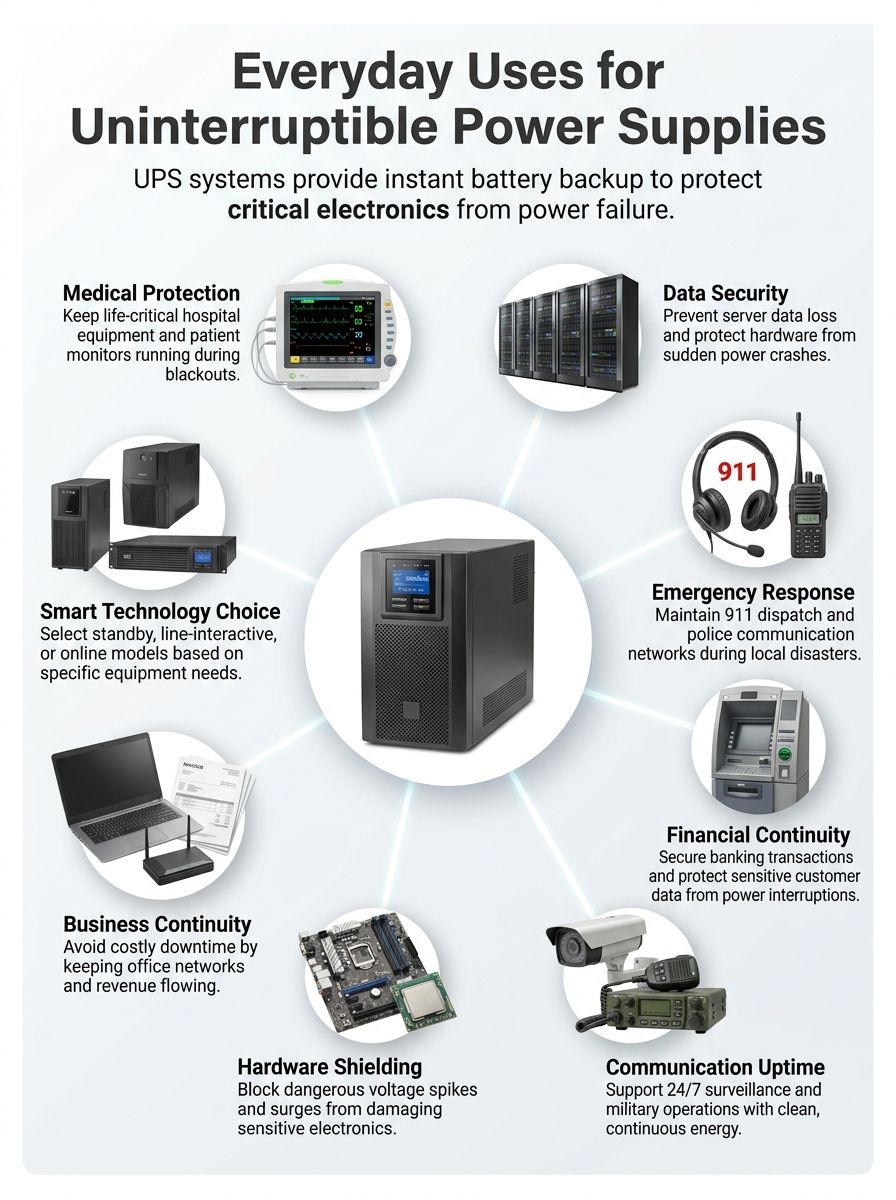
What Does an Uninterruptible Power Supply Do?
An uninterruptible power supply, or UPS, is an electrical apparatus that springs into action the moment your main power fails. It delivers emergency power using stored energy from batteries, supercapacitors, or flywheels, giving you near-instantaneous protection from power interruptions.
Your equipment never skips a beat. The UPS switches on faster than you can blink, protecting everything plugged into it. Most UPS systems last between 5 to 15 minutes, giving you enough time to start standby generators or safely shut down your critical equipment without losing your work.
A UPS does more than just keep things running. It tackles serious power quality problems that damage your devices every day. These threats include voltage spikes, sustained overvoltage, voltage sags, and harmonic distortion.
- Voltage spikes: Can fry circuits instantly and destroy sensitive components
- Sustained overvoltage: Stresses electronics over time and shortens their lifespan
- Voltage sags: Cause equipment to malfunction or crash unexpectedly
- Harmonic distortion: Degrades sensitive gear gradually until failure occurs
The system uses power conditioning to smooth out electrical noise and high-frequency transients. Battery backup works alongside surge protection to shield your data storage, computers, and medical equipment from these threats.
Line-interactive UPS models and online UPS systems handle voltage fluctuations automatically, maintaining stable AC power output even when your main supply acts up. Your data centers, business operations, and emergency systems stay protected because this device conditions power quality while delivering uninterrupted power to everything that matters most.
Common Everyday Applications of UPS
UPS systems power critical equipment across hospitals, offices, data centers, and emergency response facilities every single day. These devices protect everything from medical machines to financial networks, keeping essential operations running when the main power fails.
Powering Medical Equipment
Medical devices demand constant, reliable power to keep patients safe. Hospitals depend on uninterruptible power supply systems to run life-critical equipment in emergency rooms, operating theaters, and intensive care units without interruption.
Critical medical devices require steady power to ensure patient safety. Medical-grade power protection systems comply with industry regulations and can eliminate the need for isolation transformers, making them ideal for healthcare facilities.
According to a 2022 study highlighted by Energetica India, even millisecond power fluctuations during critical procedures like surgery or CPR can result in fatal equipment failures. This is precisely why Operation Theatres cannot rely on standby generators or offline UPS systems that carry a transfer delay. Zero-transfer-time Online UPS systems are the only acceptable solution in these environments.
- Small UPS units mount on carts to provide power during patient transfers between departments
- Lithium-ion batteries and valve-regulated lead-acid batteries power medical-grade systems
- Outdoor UPS systems withstand temperature ranges from -40°C to +55°C for mobile and field units
- Battery heater mats and cooling systems protect sensitive electronics in any environment
Healthcare providers install portable UPS units directly on medical equipment carts, ensuring continuous operation as staff moves patients through hallways and between departments.
Medical facilities trust these energy storage systems because they safeguard both patient lives and expensive medical hardware from damage caused by power surges and voltage fluctuations.
Steady power saves lives, and uninterruptible power supplies make that possible every single day in hospitals across America.
Supporting Data Storage and Computers
Your computer servers face real danger during power outages and brownouts. Data centers deploy uninterruptible power supply systems to protect their expensive equipment and secure their reputation while preventing data loss. According to a 2025 report from S&P Global Commodity Insights, India’s data center power demand is projected to grow nearly fivefold to 57 TWh by 2030, driven by digitalization and the IndiaAI Mission.
IT systems depend on UPS technology to guard against blackouts that risk security breaches, equipment damage, and the loss of protected information. Many computer servers provide redundant power supplies, each capable of independently supporting the entire server on its own.
Connecting each power supply to a different circuit enhances this redundancy. Plugging each power supply into its own UPS creates what experts call 1+1 or 2N redundancy, offering maximum protection for your critical data storage infrastructure.
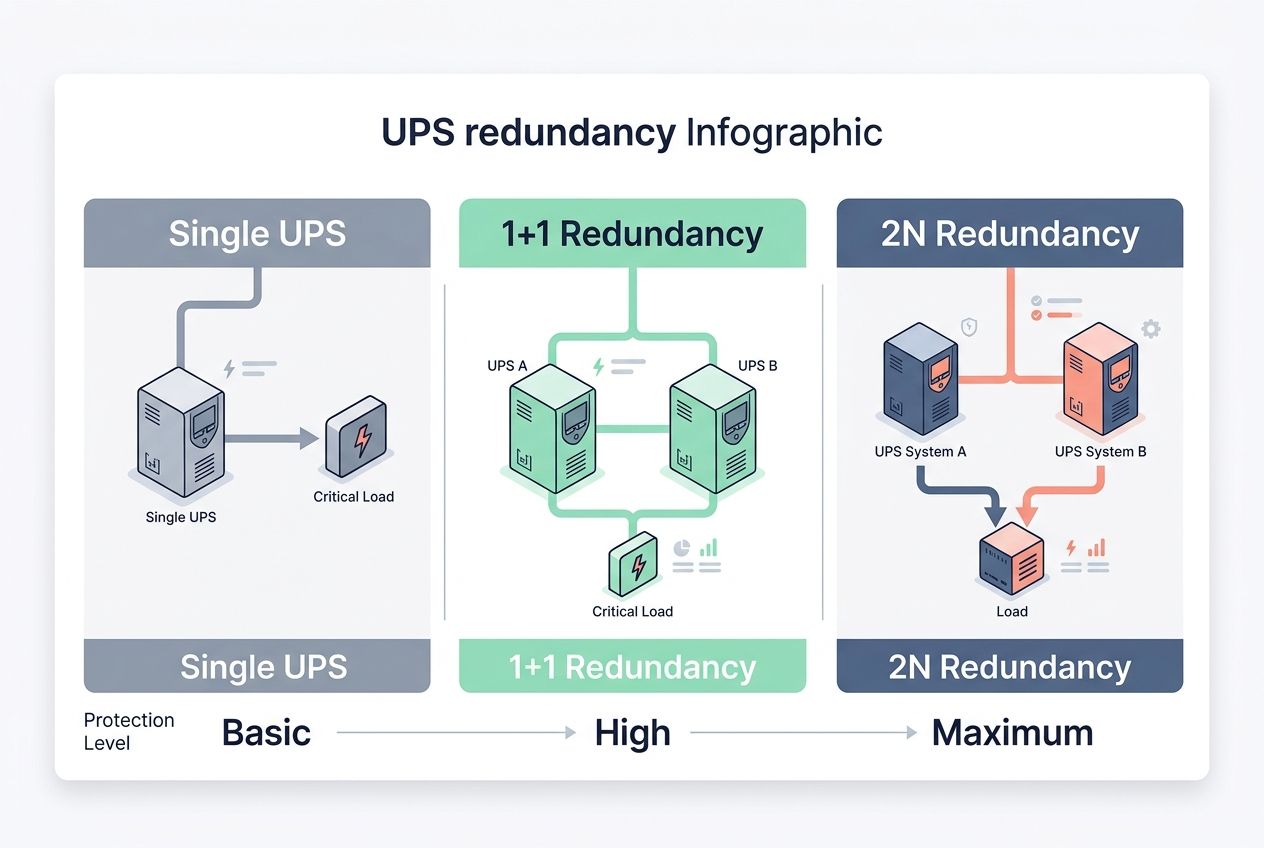
| Redundancy Type | Configuration | Protection Level |
|---|---|---|
| 1+1 Redundancy | Each power supply on its own UPS | High |
| 2N Redundancy | Full duplicate power path | Maximum |
| Single UPS | All supplies on one unit | Basic |
Data center facilities rely on smart power supply solutions to maintain continuous operations. Double-conversion UPS systems and online UPS technology work together to keep your servers running smoothly during electrical disturbances.
These systems protect the volt-amperes of power flowing through your equipment, ensuring that data center infrastructure remains stable and secure. The investment in proper UPS systems pays for itself by preventing costly hardware failures and protecting the valuable information your organization stores every single day.
Ensuring Functionality for Emergency and Law Enforcement Systems
Emergency management and law enforcement sectors depend on uninterruptible power supply systems to keep critical operations running during power outages and disasters. Police departments, fire stations, and 911 call centers rely on these power backup solutions to maintain communication infrastructure without interruption.
Water control facilities and utility companies also trust UPS technology to protect essential services that communities depend on every single day. Outdoor UPS systems can mount as pole, ground pedestal, or host-mounted units for field communications and control centers, ensuring emergency responders stay connected when the main power fails.
Advanced UPS systems now connect to control servers through GSM/GPRS channels, allowing operators to manage electrical loads by shutting down computers through SMS or data packets. This remote management capability means emergency personnel can optimize power distribution during critical situations without being physically present at the site power facility.
- Dispatch centers stay online through power failures with continuous battery backup
- Surveillance systems maintain uninterrupted operation for real-time monitoring
- Communication networks remain active so first responders can coordinate effectively
- Multi-mode and double conversion technology guards against surges and fluctuations
Law enforcement agencies benefit from this smart charging network approach, which keeps their operations running when communities need them most. These systems represent a critical layer of defense that protects public safety infrastructure every single day.
Securing Financial Operations
Banks and fintech companies protect their operations with uninterruptible power supply systems that guard against sudden outages. Power quality issues can cause significant financial losses, making UPS systems essential for keeping operations running smoothly.
Financial institutions use these systems to safeguard funds and prevent cybersecurity threats during power interruptions. A reliable UPS ensures that critical banking systems, transaction processing, and customer data remain protected at all times.
Data center facilities that house sensitive financial information depend on online UPS technology to maintain continuous operation. These systems work around the clock to prevent data loss and keep security protocols active, even when the main power fails unexpectedly.
Under the Reserve Bank of India’s (RBI) stringent digital payments and data localization frameworks, financial organizations must maintain continuous, highly secure IT uptime to process and store localized financial data safely. This makes enterprise-grade UPS infrastructure a compliance necessity, not just a preference.
| Institution Type | Recommended UPS | Primary Need |
|---|---|---|
| Large Banks | Online UPS | Maximum protection, zero transfer time |
| Fintech Companies | Line-Interactive UPS | Cost-effective voltage regulation |
| Smaller Financial Firms | Standby UPS | Basic protection and affordability |
Kstar Group and other leading manufacturers provide specialized solutions designed specifically for the financial sector’s demanding requirements. Your financial institution’s continuity depends on having the right UPS system in place before an outage occurs.
Maintaining Communication Centers
Communication centers operate around the clock to support surveillance, military operations, and security applications that cannot tolerate power interruptions. These facilities depend on uninterruptible power supply systems to keep networks, servers, and monitoring equipment running without pause.
An online UPS configuration delivers continuous, clean power through double-conversion technology, converting incoming AC power to DC and back to AC. This method eliminates any gap in power delivery, which proves critical for facilities managing sensitive data and real-time communications.
- Network management cards and Ethernet interfaces enable remote monitoring and control from anywhere
- Security protocols encrypt all status and control signals against unauthorized access
- Facilities can choose proprietary or open-standard communication protocols based on their needs
- Battery banks store energy reserves to keep surveillance and dispatch networks fully operational
A multi-mode UPS adapts to different power conditions, switching between line-interactive and online modes based on real-time demands. Modular data center designs integrate UPS technology throughout facility architecture, creating redundancy at multiple levels.
This distributed approach means that even if one component fails, backup systems immediately take over without any service interruption. Communication centers protecting national security, emergency services, and financial institutions rely on this layered protection strategy to fulfill their critical missions every single day.
Benefits of Using a UPS in Daily Life
A UPS system protects your valuable devices and files from sudden power failures that strike without warning. These backup power solutions guard your equipment against dangerous power surges and voltage swings that damage hardware and erase critical data.
Preventing Data Loss and Hardware Damage
Power outages strike without warning, and they threaten everything stored on your devices. UPS systems give employees crucial time to save their work and perform secure shutdowns before electricity vanishes completely.
This protection prevents data loss that could cripple operations for hours or days. Data center downtime costs companies thousands to millions of dollars per hour, making UPS protection a financial necessity rather than a luxury. According to a 2023 New Relic Observability Forecast report, the median cost of IT outages for organizations in India is approximately ₹520 crore ($62.79 million) annually, with 45% of businesses reporting that critical application downtime costs them over $500,000 per hour.
Higher-quality units produce nearly pure sinusoidal AC power, which shields your hardware from damage that inferior systems cause. Consumer-grade units often generate output resembling square waves rich in harmonics, and this interference can destroy sensitive electronics over time.
- Voltage fluctuations and power surges attack every connected device in your facility
- Networking equipment, servers, and specialized machinery all face risk without protection
- Online, double-conversion UPS models maintain consistent power delivery to prevent stress on hardware
- Modular data center solutions integrate advanced UPS technology to safeguard entire operations at once
Vertiv and similar providers offer systems that maintain data integrity across complex environments. Equipment failures from poor power quality force expensive repairs and extended outages that damage your reputation with clients.
Your investment in quality UPS equipment pays dividends through avoided replacement costs, prevented downtime, and preserved business continuity.
Ensuring Business Continuity
Uninterruptible power supplies keep your business running when the grid fails. Servers, data center facilities, and communication networks stay online without interruption.
Your staff continues working, customers receive service, and revenue keeps flowing. The IEC 62040-3 classification standard helps you choose the right UPS technology for your specific needs.
- Financial operations maintain transaction processing and encryption systems
- Emergency systems stay active to protect public safety
- Law enforcement networks continue coordinating without delays
- A single power failure can cost thousands of dollars in lost productivity and damaged equipment
UPS devices communicate with your operating system through serial ports, Ethernet connections, GSM/GPRS links, and USB cables to report their status. Your computer receives real-time information about power conditions and battery levels.
The operating system processes these UPS status reports and sends commands for ordered shutdowns if needed. Many computer servers feature redundant power supplies, and connecting each supply to its own UPS enhances protection even further.
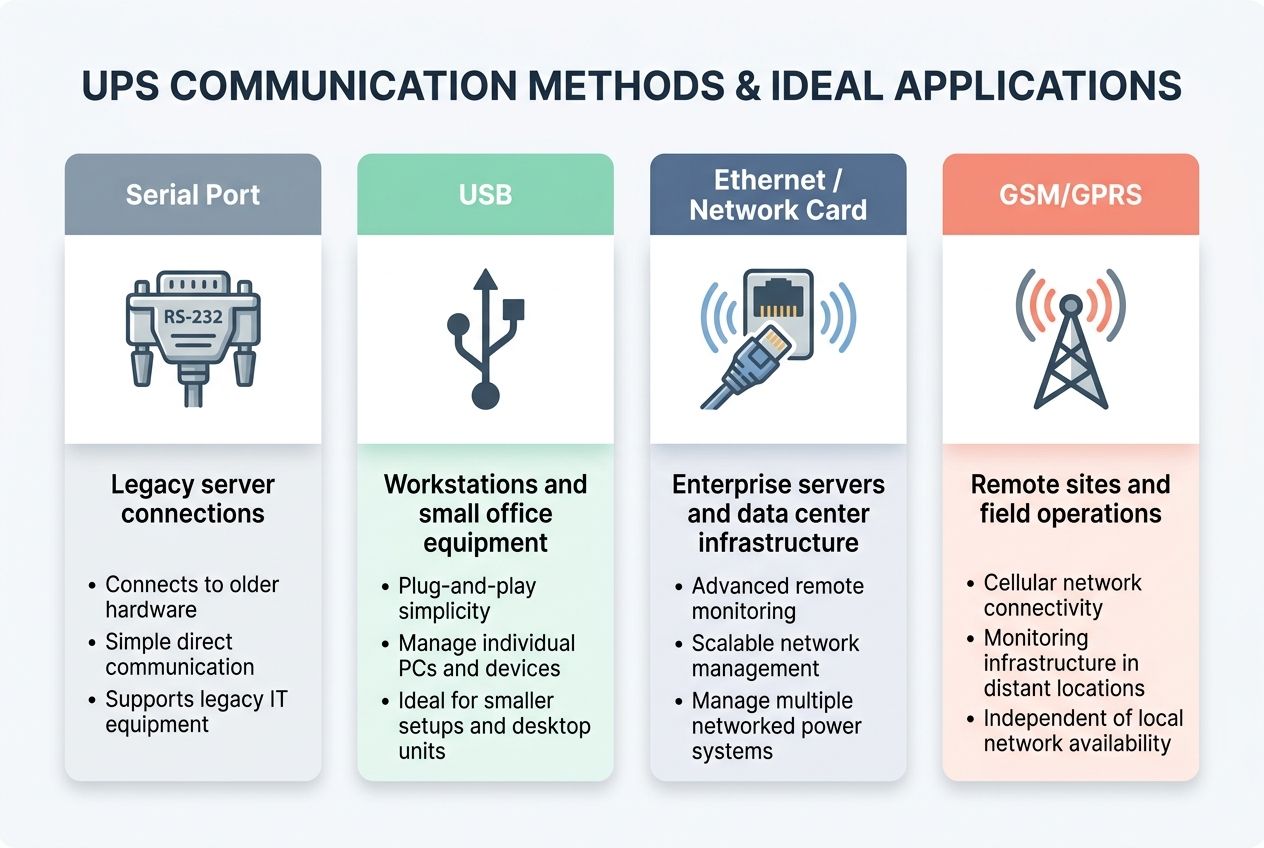
| Communication Method | Best Use Case |
|---|---|
| Serial Port | Legacy server connections |
| USB | Workstations and small office equipment |
| Ethernet / Network Card | Enterprise servers and data center infrastructure |
| GSM/GPRS | Remote sites and field operations |
Huawei Digital Power and KStar New Energy solutions offer advanced monitoring capabilities for business environments. This redundancy approach ensures your critical systems never lose power, protecting both your data and your reputation in the marketplace.
Enhancing Safety and Security
UPS systems protect critical infrastructure that keeps people safe every single day. Emergency response centers, law enforcement facilities, and security systems all depend on continuous power to function properly.
A power outage could delay emergency services, disable security cameras, or interrupt communication networks when communities need them most. UPS technology ensures these vital operations never stop, even during unexpected blackouts or voltage fluctuations.
- Fire suppression systems require constant power to respond instantly to threats
- Alarm networks stay active to alert personnel around the clock
- Access control devices need uninterrupted electricity to secure facilities at all times
- Security monitoring systems track threats and protect assets without gaps in coverage
Data center facilities that store sensitive information rely on online UPS units to maintain security protocols and prevent unauthorized access during power disruptions. These systems comply with industry standards like IEC 62040-1:2017 and IEC 62040-3:2021, which establish safety requirements that protect both equipment and people.
Facilities that implement proper UPS infrastructure avoid costly penalties from government agencies and industry regulators who demand compliance with power reliability standards. The investment in quality UPS equipment safeguards people, property, and critical operations that communities depend on for protection and security.
Protection Against Power Surges and Voltage Fluctuations
Power surges can instantly damage your electronics, frying circuits and ruining expensive devices in seconds. According to a 2020 survey conducted by NITI Aayog and Smart Power India, 28% of Indian electricity consumers are dissatisfied with their power quality, specifically citing voltage fluctuations and surges as a primary cause of damaged household electronics and appliances. This is a widespread, everyday problem, not an occasional inconvenience.
Voltage fluctuations stress your systems over time, leading to premature repairs or replacements that drain your wallet. An uninterruptible power supply protects against both threats by acting as a barrier between your equipment and unstable electrical conditions.
Line-interactive UPS models include a multi-tap variable-voltage autotransformer that manages continuous undervoltage and overvoltage without draining the battery. This smart technology keeps your devices safe during minor power problems, saving your battery power for real emergencies.
- Switches to battery only when input voltage exceeds roughly 90V to 140V for 120V systems
- Protects equipment from dangerous spikes and dips that cause immediate failure
- A 1000W device draws 10 amps at 100V instead of the normal 8.33 amps at 120V under low voltage
- The autotransformer compensates for these current changes without engaging the battery
This protection matters for data center facilities, EV charging stations, and any critical infrastructure where power stability determines success or failure. Your investment in a quality UPS system prevents data loss, hardware damage, and costly downtime that impacts your business operations.
Types of UPS Systems
Different UPS systems work in distinct ways, and each one serves specific power protection needs for homes and businesses. You can choose from offline standby models, line-interactive units, or online double-conversion systems depending on your equipment requirements and budget.
Offline/Standby UPS
An offline or standby UPS operates with basic features that protect your equipment from power problems. This system connects directly to utility power and monitors the voltage constantly.
When voltage drops below or rises above predetermined levels, the UPS switches to battery power automatically. The switch-over time reaches up to 25 milliseconds, meaning your devices experience only a brief interruption.
Most offline UPS units provide protection time between 5 to 20 minutes, giving you enough time to save your work or shut down equipment safely. This type works well for non-critical applications where a small delay in switching does not cause major problems.
- Ferroresonant UPS units use a ferroresonant transformer for output filtering and voltage regulation
- Efficiency ratings run around 82 to 88 percent for AC/DC-AC conversion
- Surge protection shields computers, data storage systems, and electronics from voltage spikes
- Lower cost makes these single-conversion UPS units popular for home offices and small businesses
Your equipment stays protected without requiring complex installation or constant maintenance. The straightforward design keeps costs lower than advanced UPS options, making them a practical entry-level choice.
Line-Interactive UPS
Line-interactive UPS systems use a multi-tap variable-voltage autotransformer that handles continuous undervoltage and overvoltage without draining the battery. This technology manages input voltage ranges from approximately 90V to 140V for 120V power, making it highly efficient for everyday applications.
The autotransformer steps in automatically when voltage fluctuates, protecting your equipment from damage. You get battery backup only when the power fails completely, which extends battery life significantly.
Most homes and small offices use line-interactive UPS for loads less than 1 kVA, making them ideal for powering computers, modems, and routers without constant battery drain.
| Power Condition | Device Load | Current Draw |
|---|---|---|
| Normal (120V) | 1000W | 8.33A |
| Low Voltage (100V) | 1000W | 10A |
During low-voltage conditions, the autotransformer compensates for the increased current draw, keeping your devices running smoothly. You avoid the sudden power interruption that offline UPS systems cause when switching to battery mode.
Line-interactive UPS provides seamless protection, making it a strong choice for data center facilities and cooling systems that require consistent power delivery. Many users choose this type because it balances cost, performance, and reliability for everyday home and small business needs.
Online/Double-Conversion UPS
Online or double-conversion UPS systems operate differently than other power backup solutions. These units keep batteries constantly connected to the inverter, which eliminates the need for power transfer switches during outages.
This continuous connection means your equipment receives uninterrupted power without any delay. The technology creates an “electrical firewall” between incoming utility power and your sensitive devices, offering ideal protection for environments that require electrical isolation.
- Data center facilities and cooling systems benefit from consistent, clean power at all times
- A static transfer switch improves reliability and overall system performance
- Modern units now serve consumer devices, often supplying less than 500W for everyday needs
- Continuous operation design improves cooling efficiency and protects hardware from electrical stress
The investment in online UPS technology costs more than other options, but the advanced components justify the expense. Organizations running critical operations, from law enforcement systems to financial operations, depend on online UPS solutions to maintain uninterrupted service during power disruptions.
Conclusion
Uninterruptible power supply systems protect what matters most, from hospitals keeping patients safe to data centers storing your critical files.
These devices stand guard against power failures, voltage spikes, and sudden blackouts that could damage equipment or erase important information. Whether you work in finance, emergency services, or simply want to protect your home computer, a UPS delivers peace of mind through battery backup and instant power switching.
Modern solutions like line-interactive and online UPS models offer different protection levels for different needs, making them practical for homes and large facilities alike.
Investing in the right uninterruptible power supply means your critical systems keep running, your data stays secure, and your operations never skip a beat.
FAQs
1. What is an uninterruptible power supply used for in everyday life?
An uninterruptible power supply, or UPS, keeps your devices running during a power outage. It protects computers, medical equipment, and data center facilities from sudden power loss. In India, where power disruptions are common in many areas, a UPS provides critical backup for both homes and businesses.
2. How does a UPS work with a PV inverter and FusionSolar systems?
A UPS works alongside a PV inverter and FusionSolar systems to store solar energy and deliver it when needed. This combination reduces your reliance on the grid and lowers electricity costs. The setup is particularly valuable in India’s growing solar market, supporting both sustainability and energy independence.
3. Can a UPS support EV charging and cooling in modular data centers?
Yes, a UPS can power EV chargers and support cooling systems in modular data centers. It ensures that critical infrastructure stays online during power fluctuations. Modern UPS systems can handle the high loads required for fast EV charging stations.
4. What makes single-conversion UPS systems like DriveOne and Astrodyne TDI reliable for everyday use?
Single-conversion UPS systems, such as DriveOne and Astrodyne TDI, operate at efficiency levels above 95 percent. They handle light to moderate power loads well, making them cost-effective for homes and small businesses. Their simpler design means fewer components that can fail, which translates to better long-term reliability.