
Last updated: July 23, 2026
Quick Answer: A 2kW inverter is a good fit for small homes and small businesses that need to power basic appliances like fans, lights, a TV, and a router. The right choice depends on your load size, battery needs, grid reliability, and whether you want to run an air conditioner. This guide walks through every key decision so you can buy with confidence.
النقاط الرئيسية
- A 2kW inverter can handle 1,500 to 2,000 watts of continuous load, which covers most basic home appliances.
- Running a standard 1-ton AC on a 2kW inverter is possible but leaves very little room for other appliances running at the same time.
- On-grid inverters are cheaper but give no backup power. Off-grid and hybrid models cost more but work during outages.
- Battery choice directly affects your backup duration and total system cost.
- Pure sine wave output is important if you use sensitive electronics or an AC unit.
- MPPT charge controllers improve solar energy harvest and are worth the extra cost.
- A 2kW string inverter in India typically costs between approximately 18,000 and 30,000 rupees for the unit alone, before battery and installation [5].
- Always check warranty terms, local service availability, and installation costs before buying.
Is a 2kW Solar Inverter Enough for Your Home?
A 2kW inverter is enough for a small home or apartment that uses basic appliances. It supports a continuous load of roughly 1,500 to 2,000 watts, which covers fans, LED lights, a television, a Wi-Fi router, and a small refrigerator running together.
Here is a simple guide to what a 2kW inverter can handle:
| جهاز | القدرة الكهربائية النموذجية |
|---|---|
| LED lights (8 bulbs) | 80 W |
| Ceiling fan (3 units) | 210 W |
| Television (42 inch) | 100 W |
| Wi-Fi router | 15 W |
| Small refrigerator | 150 W |
| كمبيوتر محمول | 65 W |
| Total estimate | ~620 W |
As you can see, a typical basic home setup uses well under 2,000 watts. That gives you room for a few more appliances or occasional higher loads.
However, a 2kW inverter is not suitable if you plan to run multiple air conditioners, a large water pump, or heavy workshop equipment at the same time. For those needs, a 3kW or 5kW inverter is a better fit.
Choose a 2kW inverter if: Your daily load is under 1,800 watts and you have 2 to 4 rooms with basic appliances.
Can a 2kW Solar Inverter Run an AC?
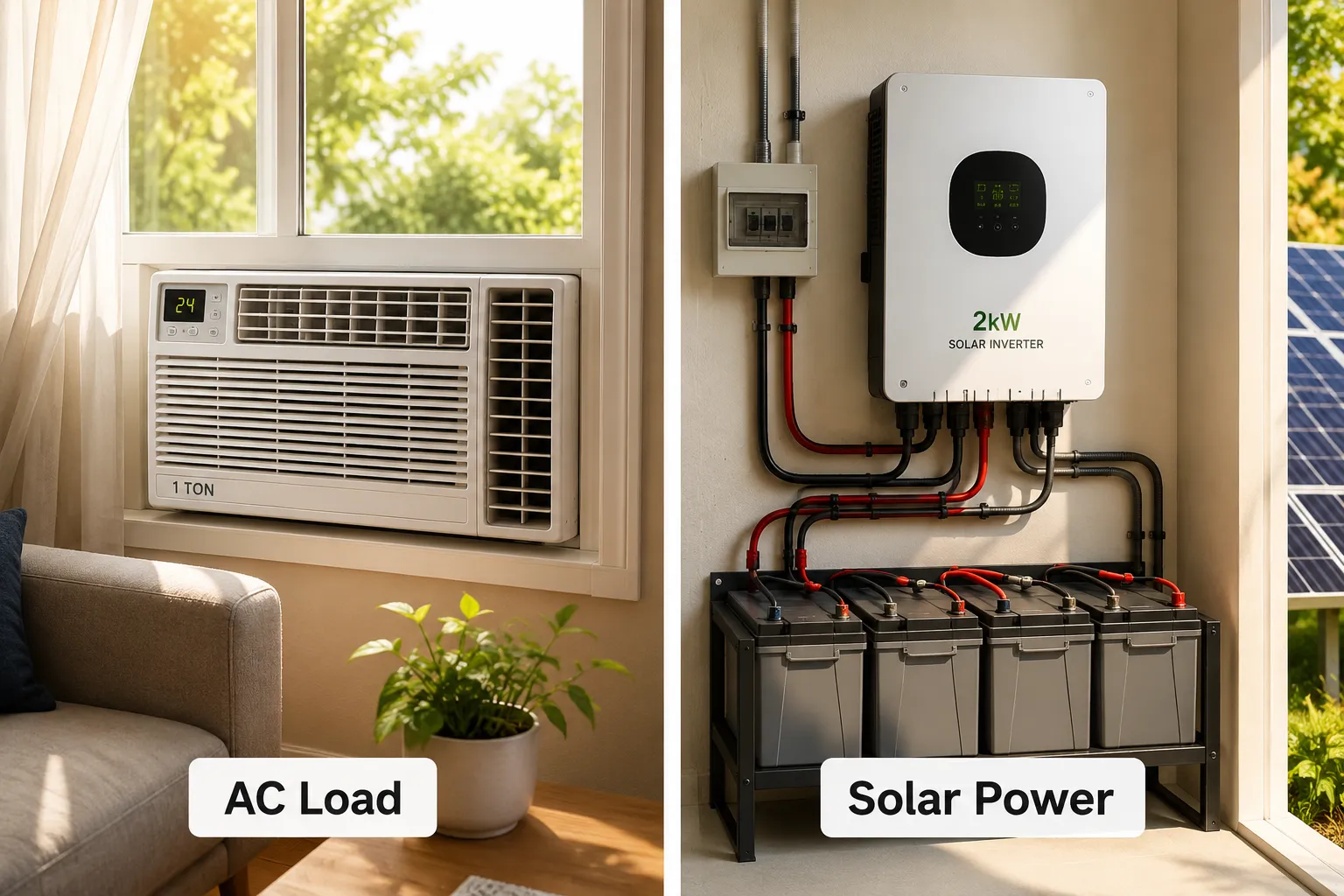
Yes, a 2kW inverter can run a small air conditioner, but it depends on the AC tonnage and what else is running at the same time.
A 1-ton split AC typically draws around 900 to 1,200 watts when running. At startup, it can surge to 2,000 watts or more for a few seconds. This means a 2kW inverter can handle a 1-ton AC, but you need to turn off other heavy appliances while the AC is on.
Key points to understand:
- 1-ton AC: Possible on a 2kW inverter, but leave minimal margin for other loads.
- 1.5-ton AC: Not recommended. The running load alone can exceed 1,500 watts, and the startup surge will likely trip the inverter.
- Startup surge: Always check the inverter’s peak or surge watt rating, not just the continuous rating.
- Pure sine wave output: Required for AC units. A modified sine wave inverter can damage the compressor motor over time [7].
A practical rule: if you want to run a 1-ton AC on a 2kW inverter, do not run a refrigerator, microwave, or other motor-driven appliance at the same time.
On-Grid, Off-Grid, or Hybrid: Which One Should You Choose?
The inverter type matters as much as the watt rating. Each type suits a different situation.
On-grid (grid-tied) inverter:
- Works only when the utility grid is active.
- Feeds excess solar power back to the grid (net metering).
- No battery needed, so the upfront cost is lower.
- Best for: homes with stable city electricity and low electricity bills as the main goal.
Off-grid inverter:
- Works independently from the grid.
- Requires a battery bank to store solar energy.
- Best for: villages, remote areas, or places with very frequent power cuts.
Hybrid inverter:
- Connects to both the grid and a battery.
- Charges the battery from solar and uses grid power as a backup.
- Best for: homes that want electricity bill savings and also need backup during outages.
For most small business owners and homeowners in areas with 4 to 8 hours of daily power cuts, a hybrid 2kW inverter is the most practical choice in 2026.
How Battery Choice Changes Your 2kW Solar Inverter Price
Adding a battery to your 2kW solar inverter system significantly changes the total cost and the backup duration you get.
Without battery (on-grid only):
- Lower system cost.
- No backup during grid failure.
- Good for areas with stable electricity.
With battery:
- Higher upfront cost.
- Provides backup power during outages.
- Backup duration depends on battery capacity and your load.
Backup duration estimate (at 500W average load):
| Battery Capacity | Estimated Backup Time |
|---|---|
| 100 Ah / 12V (1.2 kWh) | ~2 hours |
| 150 Ah / 12V (1.8 kWh) | ~3 hours |
| 200 Ah / 24V (4.8 kWh) | ~8 hours |
Battery types to consider:
- Lead-acid (flooded): Lower purchase price but needs regular water top-up and ventilation. Lifespan is typically 3 to 5 years with proper care.
- Sealed lead-acid (AGM/VRLA): Maintenance-free, safer indoors, slightly higher cost than flooded.
- Lithium (LiFePO4): Higher upfront cost but longer lifespan (8 to 12 years), lighter weight, and deeper discharge capability.
Always confirm that your chosen inverter is compatible with the battery chemistry you plan to use. Hybrid inverters are designed to work with battery storage and manage charging automatically [6].
Pure Sine Wave, MPPT, and Other Features That Matter
Not all 2kW inverters are built the same. Two features make a big difference in real-world performance.
Pure sine wave output:
A pure sine wave inverter produces clean AC power similar to what comes from the utility grid. This is important for:
- Air conditioners and refrigerators (motor protection)
- Computers and laptops
- المعدات الطبية
- Any device with a sensitive power supply
A modified sine wave inverter costs less but can cause humming in motors, overheating in some appliances, and shortened lifespan in sensitive electronics. For home use, always choose pure sine wave [7].
MPPT charge controller:
MPPT (Maximum Power Point Tracking) is a technology that extracts the maximum available power from your solar panels, even when sunlight is not at its peak. Compared to older PWM controllers, MPPT can improve solar energy harvest by 20 to 30 percent in real conditions. This matters most in areas with variable weather or partial shading.
Other features worth checking:
- Overload and short-circuit protection: Protects the inverter and connected appliances.
- Low battery cutoff: Prevents deep discharge that damages batteries.
- LCD or app monitoring: Lets you track power generation, battery level, and load in real time.
- Wide solar input voltage range: Gives flexibility when choosing solar panel configurations.
Key Questions to Ask Before Buying a 2kW Inverter
Answering these questions before you go to a supplier will save you money and avoid regret later.
1. How many hours of backup do I need?
Calculate your average load in watts and multiply by the hours you need backup. That gives you the battery capacity (in watt-hours) required.
2. What is my daily power consumption?
Add up the wattage of all appliances you use and estimate daily hours of use. If your daily consumption is above 8 to 10 kWh, a 2kW system may not be enough on its own.
3. Do I need net metering?
Net metering lets you sell excess solar power back to the grid. This requires an on-grid or hybrid inverter and registration with your local utility. Check if your area supports net metering before buying.
4. What warranty does the inverter offer?
Most quality inverters come with a 2 to 5 year warranty. Some brands offer extended warranties for an additional cost. Always read what the warranty covers, some only cover manufacturing defects, not installation issues.
5. Is local service available?
An inverter with no local service center is a risk. Ask the supplier about after-sales support, spare parts availability, and how long repairs typically take.
Typical 2kW Solar Inverter Price Ranges by Use Case
Prices vary by region, brand, and system type. The figures below are general estimates for guidance in 2026.
Budget backup setup (off-grid, lead-acid battery):
- Inverter only: approximately 18,000 to 25,000 INR for a basic 2kW unit in India [5].
- Add a 150Ah lead-acid battery: adds roughly 10,000 to 14,000 INR.
- This setup gives 3 to 4 hours of backup for basic loads.
- Best for: villages and areas with very frequent outages where cost is the main concern.
Standard home solar setup (hybrid, sealed battery):
- Inverter: approximately 25,000 to 40,000 INR.
- Add 2 x 150Ah AGM batteries: adds roughly 25,000 to 35,000 INR.
- Solar panels (4 x 500W): adds to the total system cost.
- Best for: suburban homes wanting both savings and backup.
Premium hybrid setup (lithium battery, MPPT, monitoring):
- Inverter with built-in MPPT and app monitoring: higher price range.
- Lithium battery (2 kWh): significantly higher upfront cost but lower long-term cost.
- Best for: small business owners who need reliable power and can invest more upfront.
For context, the Anker Solix C2000 Gen 2, a 2kWh portable power station with 2,400W continuous output, launched in early 2026 at approximately 1,499 EUR, showing the premium end of the portable 2kW power market [1].
Common mistake: Many buyers look only at the inverter price and forget to budget for batteries, solar panels, wiring, mounting hardware, and installation labor. The inverter is often just 30 to 40 percent of the total system cost.
Common Buying Mistakes to Avoid
These mistakes are easy to make and expensive to fix.
- Choosing by lowest price only. A cheap inverter with no warranty or local service can cost more in the long run through repairs and replacements.
- Ignoring warranty terms. Read the warranty carefully. Some low-cost brands offer a 1-year warranty that does not cover labor or shipping costs.
- Mismatching battery and inverter. Not all inverters work with all battery types. A lithium battery connected to an inverter designed for lead-acid will not charge correctly and may be damaged.
- Not checking rooftop solar compatibility. If you plan to add solar panels, confirm the inverter’s maximum solar input voltage and current. Oversizing the panel array beyond the inverter’s rating wastes money and can damage the unit.
- Forgetting installation and service costs. Installation by a qualified electrician, mounting hardware, wiring, and circuit breakers add to the total cost. Get a full quote before committing.
- Buying modified sine wave when you need pure sine wave. This is a common cost-cutting mistake that causes appliance damage over time.
Best 2kW Solar Inverter Setup for Small Homes
The best setup depends on where you live and how you use power.
Small family home (2 to 3 bedrooms, city or suburb):
- Hybrid 2kW pure sine wave inverter with MPPT.
- 4 x 400W to 500W solar panels on rooftop.
- 2 x 150Ah sealed lead-acid or 1 x 2kWh lithium battery.
- This setup covers daily basic loads and gives 4 to 6 hours of backup.
Apartment rooftop (limited panel space):
- On-grid 2kW inverter with net metering.
- 4 x 400W panels (total 1.6kW to 2kW array).
- No battery needed if grid is reliable.
- Reduces electricity bill significantly.
Village or semi-urban area (frequent outages, no reliable grid):
- Off-grid 2kW pure sine wave inverter.
- 4 to 6 solar panels.
- 2 x 200Ah flooded lead-acid batteries for maximum backup at lowest cost.
- Focus on durability and ease of local maintenance.
For small business owners running a shop, office, or small workshop, the hybrid setup is usually the best balance. It keeps the lights and computers on during outages and reduces the monthly electricity bill at the same time.
Sungrow’s newer microinverter technology, such as the S2500S-L introduced in 2025, shows how the industry is moving toward higher efficiency (up to 96.5%) and better temperature tolerance [2]. When buying a 2kW inverter in 2026, look for models that reflect these efficiency improvements.
الأسئلة الشائعة
What does a 2kW inverter do?
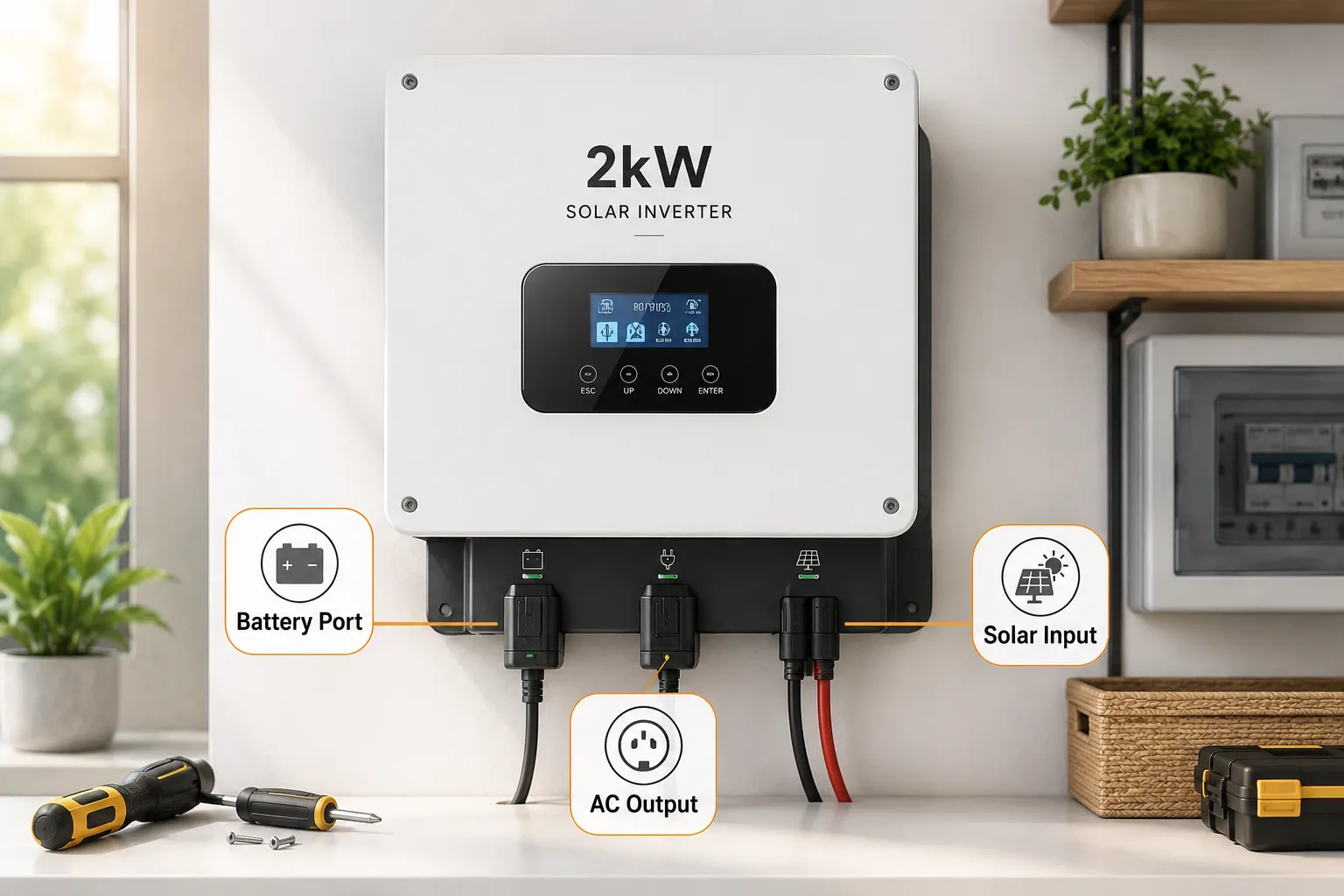
A 2kW inverter converts DC power (from solar panels or a battery) into AC power that home appliances can use. It manages the flow of electricity between your solar panels, battery, and home loads.
Who needs a 2kW inverter?
A 2kW inverter is ideal for small homes, apartments, or small offices with basic appliance loads under 2,000 watts. It suits families of 2 to 4 people who use fans, lights, a TV, and a small refrigerator.
2kW inverter vs 3kW inverter: which is better?
A 2kW inverter is better if your load stays under 2,000 watts and budget is a concern. A 3kW inverter is better if you want to run a 1.5-ton AC or plan to add more appliances in the future. Choose based on your actual load, not just the price difference.
How long does a 2kW inverter last?
A quality 2kW inverter typically lasts 8 to 12 years with proper installation and maintenance. Cheaper units may last only 3 to 5 years. Warranty length is a good indicator of the manufacturer’s confidence in the product.
What is the 2kW inverter load capacity?
The continuous load capacity is typically 2,000 watts (2kW). Most models also have a surge or peak capacity of 4,000 watts for a few seconds to handle motor startups. Always check both ratings before buying.
2kW inverter not charging battery: what should I check?
First, check that the solar panels are receiving sunlight and the connections are secure. Then verify that the battery voltage is within the inverter’s acceptable input range. Check the inverter display for fault codes. Common causes include a blown fuse, a loose connection, a battery that is too deeply discharged, or a mismatch between battery type settings and the actual battery installed.
What is the difference between pure sine wave and modified sine wave in a 2kW inverter?
Pure sine wave produces clean AC power safe for all appliances including motors, ACs, and electronics. Modified sine wave is cheaper but can cause humming, overheating, or damage in sensitive devices. For home use, always choose pure sine wave.
What are the 2kW inverter installation requirements?
You need a qualified electrician, proper cable sizing (typically 6 to 10mm² DC cables), a dedicated circuit breaker, adequate ventilation around the inverter, and a stable mounting surface. The inverter should be installed away from direct sunlight and moisture.
Is a 2kW inverter enough for a home?
For a small home with basic appliances and no air conditioner running continuously, yes. For a larger home or one with a 1.5-ton or larger AC, a 3kW or 5kW inverter is a better choice.
How much does a 2kW inverter cost?
In India, a basic 2kW string inverter costs approximately 18,000 to 30,000 INR for the unit alone [5]. In international markets, prices vary widely by brand and type. A complete system with battery and panels costs significantly more.
What brands make good 2kW inverters?
Established brands with global service networks include Sungrow, Growatt, Luminous, Microtek, and Sukam, among others. Sungrow in particular has demonstrated strong efficiency ratings and reliability in recent product launches [2]. When choosing a brand, prioritize local service availability and warranty terms over brand name alone.
Can a 2kW inverter work with solar panels and battery at the same time?
Yes, but only if it is a hybrid inverter. A hybrid 2kW inverter manages solar input, battery charging, and AC output simultaneously. A basic on-grid inverter does not support battery storage.
الخلاصة
A 2kW inverter is a practical and cost-effective choice for small homes, apartments, and small businesses with moderate power needs. The key is to match the inverter type to your actual situation.
Actionable next steps:
- Calculate your total appliance load in watts. If it is under 1,800 watts, a 2kW inverter is a good fit.
- Decide if you need battery backup. If yes, choose a hybrid or off-grid model with MPPT.
- Check if your area supports net metering. If yes, an on-grid or hybrid setup can reduce your electricity bill.
- Always choose pure sine wave output, especially if you plan to run an AC or sensitive electronics.
- Get a full system quote that includes panels, battery, wiring, and installation, not just the inverter price.
- Ask about warranty terms and local service support before finalizing your purchase.
At Newpro Power, we have been supplying solar inverters, UPS systems, and voltage stabilizers from Foshan, China for over 15 years. We export to markets including the Philippines, Indonesia, Africa, and beyond. If you are a distributor, wholesaler, or project contractor looking for reliable 2kW inverter solutions at competitive prices, contact our team for a product recommendation and quote.