
You know how a 1.5 ton air conditioner can look “fine” on paper, then start tripping the moment your neighborhood voltage sags at night?
In India, that gap between the rated power supply and real-world voltage fluctuations is exactly why a properly sized voltage stabilizer still matters for many homes.
Most 1.5 ton split ACs you’ll see today land around 1,400 to 1,900 watts at rated cooling conditions, which often works out to roughly 6 to 9 amps on a 230V line (your unit’s nameplate is the truth here).
In practical terms, a 4 kVA stabilizer is the safest “default” for a 1.5 ton AC in India, and 5 kVA makes sense when you deal with low voltage, higher voltage, or tougher compressor starts.
So, I’m going to walk you through the voltage range your AC can really tolerate, how to size kVA from wattage and amps, the stabilizer features that actually prevent damage, and which brands and models are commonly chosen in India.
Key Takeaways
- A 1.5 ton AC commonly draws about 1,400 to 1,900 W at rated conditions (check your AC sticker), which is often 6 to 9 amps on 230V.
- For most homes in India, choose a 4 kVA voltage stabilizer for a 1.5 ton AC, and step up to 5 kVA if you see frequent low voltage, higher voltage, or harsh starts (some brands explicitly recommend 4 kVA for 1.5 ton units).
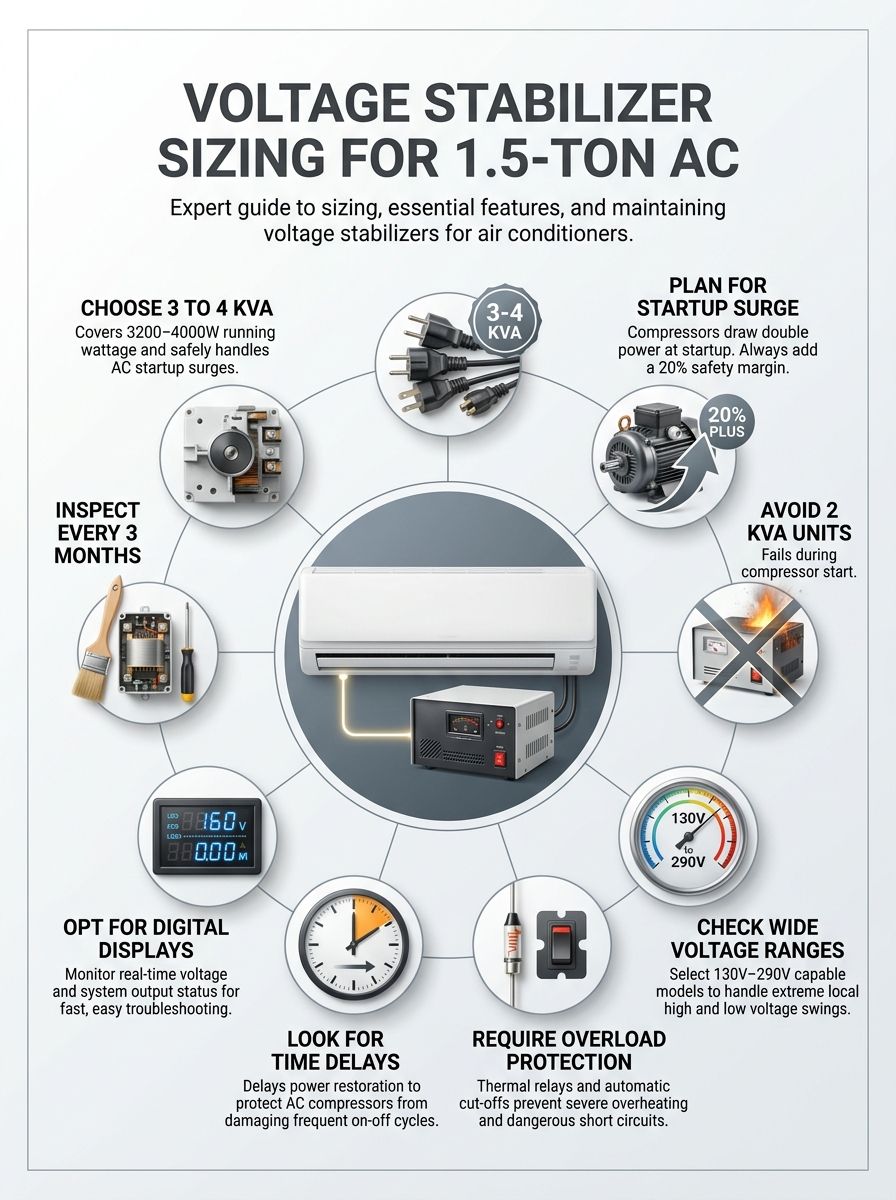
- Pick a stabilizer with a wide input range (for example, 130V to 300V if your area dips hard), plus time-delay, thermal overload protection, and high/low voltage cut-off.
- Avoid 2 kVA for a 1.5 ton air conditioner. It often lacks headroom for compressor startup surge and can lead to nuisance trips or long-term compressor stress.
- Log your input/output voltage quarterly with a multimeter, keep the stabilizer clean and ventilated, and service it yearly for reliable voltage regulation and safety.
Why Do You Need a Stabilizer for a 1. 5-Ton AC?
Your 1.5 ton AC is basically two things that hate bad electricity: a compressor (motor load) and a control board (electronics). When your power supply sees low voltage, high voltage, or rapid swings, both parts run hotter and fail sooner.
India’s legacy supply rules historically targeted tight voltage limits at the consumer end, but real neighborhoods still see voltage drops during peak load. The Indian Electricity Rules, 1956, for example, states that low or medium voltage should not vary by more than 6% from the declared voltage, yet many homes still experience wider swings in practice.
Many modern inverter AC models advertise “stabilizer-free” operation across a broad ac voltage window, but that statement is not a free pass for every lane, every season, and every wiring condition. If your AC cuts off on undervoltage, struggles to start, or your lights visibly dim when the compressor kicks in, a right stabilizer can prevent repeated stress cycles.
Here’s what a stabilizer actually does: it uses a transformer and switching control (often relay-based, sometimes servo-based in larger systems) to keep the output closer to the safe band. Good units also add safety features like thermal overload protection and automatic cut-off, which disconnect the load during unsafe input conditions or overload.
If your home runs an inverter, inverter & inverter batteries, or solar panels, you may also consider a mainline voltage stabilizer at the incoming line. That approach safeguards more electrical appliances at once, such as a refrigerator, television, and even a geyser, but it requires careful sizing and professional installation.
- Use an AC stabilizer if voltage fluctuations are frequent, especially in summer peaks.
- Prioritize a wider input range if your measured low voltage regularly drops under 170V.
- Consider a mainline stabilizer if multiple circuits see the same voltage drops, or if solar and backup systems share your home supply.
Understanding Voltage and Wattage Requirements
Before you shop, separate three terms that get mixed up all the time: tonnage, cooling capacity, and electrical input.
A 1.5 ton air conditioner is roughly 18,000 BTU/hour of cooling. In many procurement specs used in India, 1.5 ton cooling capacity shows up near 5,050 W of cooling output, which is not the same as the watts you pay for on your electricity bill.
What you pay for is the electrical input (watts), and that number is usually far lower. Real products often show rated input around the mid-1,000-watt range, depending on star rating, ambient conditions, and whether it is an inverter AC or a non-inverter AC.
To size a stabilizer, you care about VA (volt-amps) and kVA capacity, because motors and power electronics do not behave like a pure resistive load.
- Watts (W) is real power.
- VA is apparent power (what the stabilizer and wiring must handle).
- kVA is VA divided by 1,000.
- Amps (A) is current, and high current is what heats wires, terminals, and relays.
Ideal Voltage Range for a 1.5-Ton AC
In India, single-phase supply is typically declared around 230V. Under older Indian Electricity Rules guidance, the allowed variation was commonly cited as within ±6% of declared voltage, which puts a 230V supply roughly in the 216V to 244V band on paper (real grids can move beyond this in local pockets).
What matters more is your AC unit’s own tolerance and your home’s observed voltage dips. Many stabilizers are sold in bands like 160V to 285V, 170V to 270V, and “wide range” options like 130V to 300V.
For example, V-Guard lists models like VG 400 for AC up to 1.5 ton with a working range of 170V to 270V, plus an intelligent time-delay system (3 minutes class). Microtek’s 1.5 ton AC stabilizer EM 4160+ lists automatic cut-off beyond 160V and 285V.
Here’s the simple way to pick the working range that fits your local electricity:
- Measure your wall voltage (at the AC socket) at three times: early morning, evening peak, and late night.
- Write down the lowest and highest reading you see over a week.
- Pick a stabilizer whose input range comfortably covers your real min and max, then confirm its output regulation and cut-off behavior.
Recommended Wattage and KVA Capacity
Your stabilizer needs enough headroom for the running load and the startup surge of the compressor. For fixed-speed (non-inverter) compressors, the start surge can be multiple times the running current, while inverter compressors generally ramp up more gently and reduce the spike.
In India, several AC and stabilizer brands commonly position 4 kVA as the standard pick for a 1.5 ton air conditioner, and some brand guidance for AC stabilizers pushes 1.5 ton buyers toward 4 to 5 kVA when voltage drops are common.
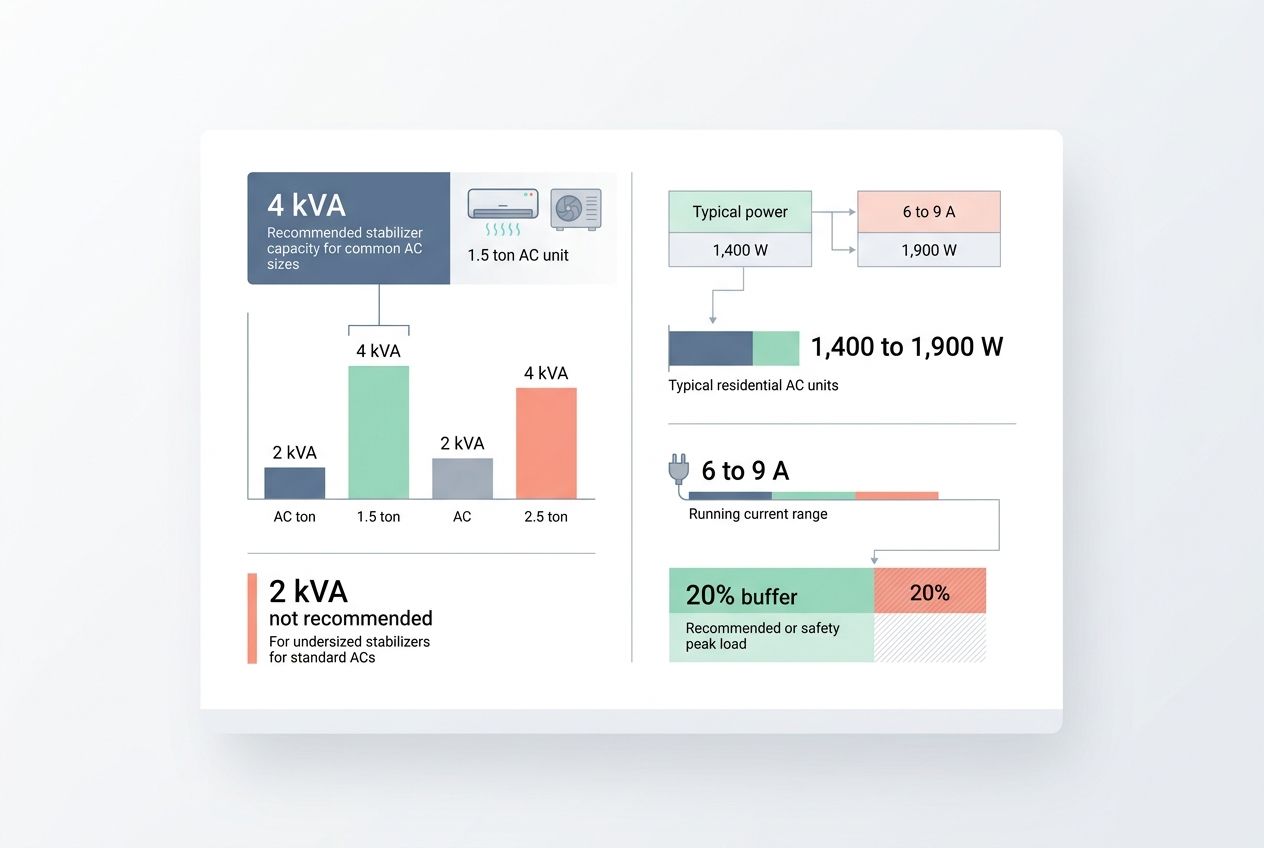
| Item | Recommendation | Why it matters | Example / Tools |
|---|---|---|---|
| Practical kVA pick for 1.5 ton AC (India) | 4 kVA (baseline), 5 kVA (tough grids) | Gives headroom for compressor starts and voltage drops without nuisance trips | Check stabilizer label: kVA/VA rating, max current (A) |
| Typical rated electrical input you may see | About 1,400 to 1,900 W (varies by model) | Helps you estimate running amps and confirm that your stabilizer is not undersized | AC nameplate, BEE label, clamp meter |
| Back-of-envelope running current at 230V | About 6 to 9 A | Current drives heating at terminals and relays, which impacts safety and reliability | Amps ≈ Watts ÷ 230V (verify on label) |
| Insufficient option | 2 kVA not recommended | Often fails during compressor start, especially under low voltage, leading to trips and stress | Avoid “generic 2 kVA” units for 1.5 ton ACs |
| Startup surge rule of thumb | Plan for 2× running load for non-inverter compressors | Startup surge is what punishes undersized stabilizers, relays, and wiring | Clamp meter with inrush capture helps confirm |
| Safety margin for home setups | Add ~20% buffer | Covers brief spikes, wiring losses, and measurement uncertainty | Use a 1.2 multiplier on your estimate |
| Quick example | If total running load = 1000 W, target about 1.2 kVA | Shows how buffering works, then scale the idea up to AC sizing | 1000 W → 1200 VA (then adjust for motor surge) |
Key Features to Look for in a Stabilizer
Once you’ve chosen the right kVA and voltage range, the next step is making sure the stabilizer is built for an air conditioner, not a generic load.
For India homes, I look for three layers: regulation quality (steady output), protection (cut-off and overload), and usability (clear monitor so a customer can confirm inputs during installation or warranty checks).
- High and low voltage cut-off (automatic cut-off when input goes out of range)
- Time-delay system (helps protect the compressor during quick power restoration)
- Thermal overload protection (prevents overheating damage under overload)
- Surge protection (basic spike handling, plus consider a panel SPD for stronger transient protection)
- Clear digital display (input/output voltage visibility reduces guesswork)
- Standards and build (many servo stabilizers reference IS 9815; check the product documentation)
Voltage Range Compatibility
Start with your measured low voltage and higher voltage at the AC socket, then match it to the stabilizer’s input range. If your supply rarely falls below 180V, a standard-range unit may be enough. If you routinely dip lower, you want a wide-range ac stabilizer that keeps working instead of cutting off.
To keep this concrete, here are examples of how real models position their working ranges in India:
- Standard fluctuation areas: V-Guard VG 400 lists 170V to 270V working range for AC up to 1.5 ton, with a 3-minute class intelligent time-delay system.
- Urban areas with occasional high/low events: Microtek EM 4160+ lists automatic cut-off beyond 160V and 285V.
- Low voltage pockets: Brands like Aulten sell 4 kVA models positioned as wide-range options (for example, configurations sold as 130V-class input ranges), which can reduce nuisance cut-offs when the neighborhood supply drops hard.
If you’re using power backup solutions (inverter and inverter batteries) or solar power system setups, confirm that the stabilizer’s cut-off and time delay system play nicely with your inverter output. Some combinations can “hunt” during marginal voltage, causing repeated restarts.
Overload and Surge Protection
Overload protection is non-negotiable. It disconnects output during short circuits or when the stabilizer sees heavy amps beyond its rating. Thermal overload protection adds a second safety layer by tripping when internal temperature rises, which protects the transformer and relay assembly.
Also be clear about what a stabilizer can and cannot do. A stabilizer helps with sustained voltage fluctuation and voltage drops, but lightning-class transient spikes are a different problem. If you want stronger surge protection, electricians commonly install a Type 2 surge protection device (SPD) in the distribution board as part of a layered safety approach, based on IEC guidance for SPDs.
- For everyday protection: stabilizer with high/low cut-off + overload protection.
- For panel-level safety: MCB/RCCB plus a correctly earthed SPD installed by a qualified electrician.
- For wet zones: never mount a stabilizer inside a bathroom. If you have appliances near wet areas, use correct circuit protection and keep all devices away from splash and humidity.
Digital Display Features
A clear digital display sounds like a small feature, until you need to troubleshoot a compressor trip at 11 pm. For AC use, you want at least input voltage visibility, and ideally output voltage and status indicators.
V-Guard’s iMagno series highlights real-time mains input voltage and stabilizer status indication on its display, while Microtek’s EM-series AC stabilizers also focus on visible voltage monitoring for quick checks.
Use the display as your day-to-day monitor, then validate with a multimeter a few times a year. If the unit shows persistent overheat or cut-off behavior under normal loads, treat it as a warning sign, not an inconvenience.
Energy Efficiency
A voltage stabiliser is a protection device first. It’s not a magic way to cut your electricity bill.
That said, stable voltage can reduce stress on the compressor and electronics during low voltage events, which can reduce nuisance trips and service calls. Microtek, for example, markets “Save Power Technology” as part of its stabilizer line, which is positioned around performance and reliability during voltage fluctuations.
If you want the biggest money impact, focus on what actually moves the needle:
- Choose an efficient AC (higher star rating or better seasonal efficiency) sized correctly for your room.
- Keep filters clean and outdoor coils unobstructed, so the unit doesn’t draw extra watts to achieve the same cooling.
- Use the stabilizer to safeguard the ac unit when your electricity supply is unstable, especially at peak load times.
Best Stabilizer Options for 1. 5-Ton ACs
For a typical 1.5 ton split AC in India, I’d shortlist 4 kVA first, then move to 5 kVA if your low voltage is frequent, your wiring run is long, or you’ve seen repeated compressor start issues.
Beyond kVA, check the stabilizer’s maximum current rating (amps), input working range, and whether it includes automatic cut-off, time delay system behavior, and overload protection.
Popular Brands and Models
These are commonly chosen options in India, with model positioning that matches real use cases. Always confirm the exact working range and warranty on the current model variant before you buy.
- V-Guard VG 400: rated for AC up to 1.5 ton with 170V to 270V working range, 12A class rating, and a 3-minute class intelligent time delay system (specs listed by V-Guard).
- V-Guard iMagno 410: positioned for 1.5 ton inverter AC protection with a listed 170V to 270V working range and a digital display for mains input monitoring.
- Microtek EM 4160+: positioned as a 1.5 ton AC stabilizer with low and high cut-off beyond 160V and 285V (as listed by Microtek).
- Aulten 4 kVA AC stabilizers: sold in variants positioned for wide-range protection, including configurations marketed for low voltage neighborhoods and inverter AC use.
- Monitor and Bluebird: commonly sold in 4 kVA-class wall-mount models for split AC use, often with copper winding claims and longer replacement-style warranties depending on the seller and model.
Comparison of Features and Pricing
Prices move a lot by season and retailer. Still, it helps to anchor your cost expectations before you shop, especially if you’re balancing brand, warranty, and wide-range capability.
As of early 2026, you’ll often see mainstream 1.5 ton AC stabilizers priced in the low-thousands of rupees, while mainline voltage stabilizers for the whole home can jump into five figures depending on kVA and build.
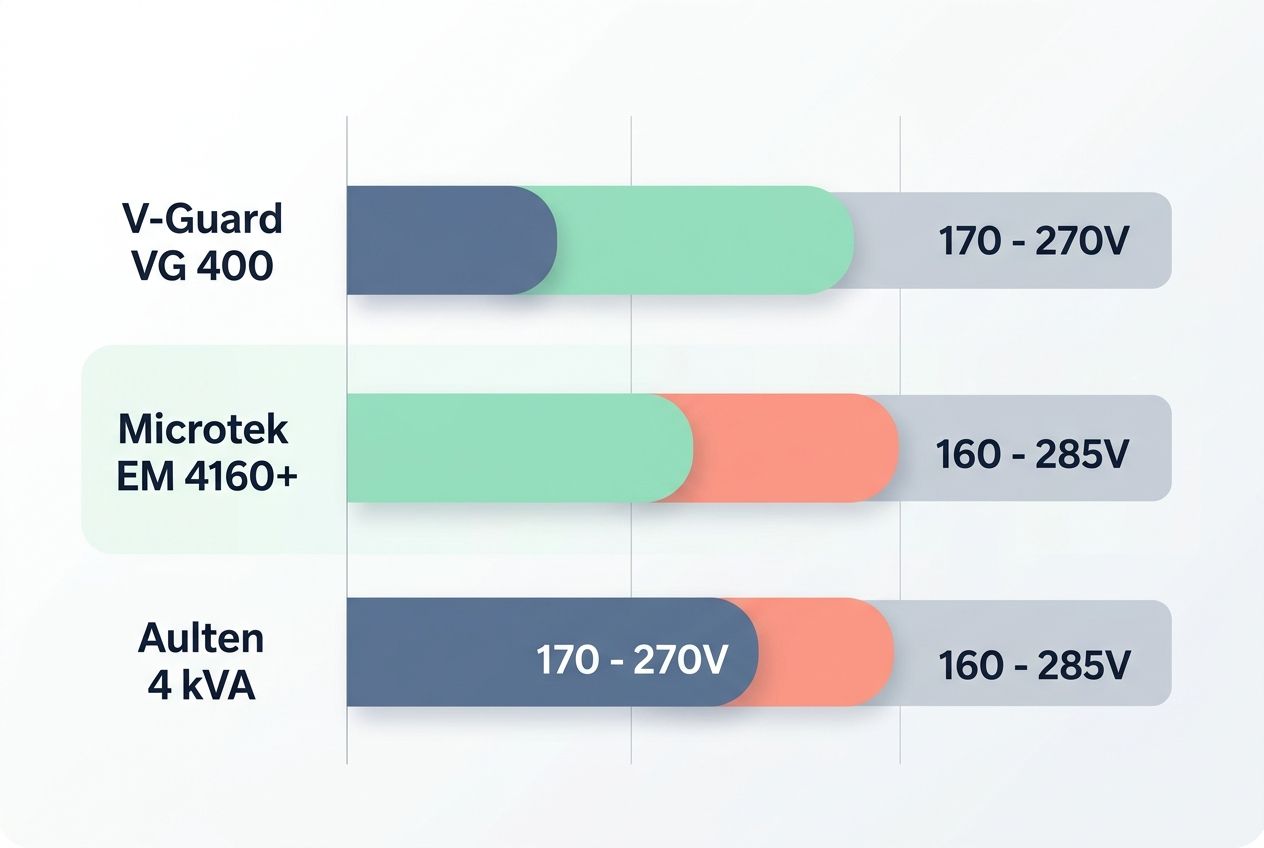
| Model | Capacity Class | Working Voltage Range (V) | Key Features | Cost Guidance (India) |
|---|---|---|---|---|
| V-Guard VG 400 | AC up to 1.5 ton | 170 – 270 | Thermal overload protection, high/low cut-off, time delay system, AC-focused design | Commonly seen around ₹2,000 to ₹3,000 depending on seller and offers (check current listing) |
| V-Guard iMagno 410 | AC up to 1.5 ton (inverter focus) | 170 – 270 | Microcontroller-based design positioning, digital display for mains input monitoring | Usually priced higher than entry models, varies by variant and season |
| Microtek EM 4160+ | 1.5 ton AC stabilizer | Cut-off beyond 160 / 285 | Automatic cut-off, voltage monitoring, positioned for frequent voltage fluctuations | Microtek has listed it around ₹4,700 on its own product page, while marketplace pricing can be lower (compare before buying) |
| Aulten 4 kVA AC stabilizer (variant-based) | 4 kVA class | Varies by model (wide-range options sold) | Digital display, cut-off features, wide-range variants for low voltage areas | Mid-range pricing varies by exact variant and input range |
| V-Guard VGMW 500 Plus (mainline) | 5 kVA mainline voltage stabilizer | Often sold as wide-range (90 – 300 class) | Whole-home safeguard approach for multiple electrical appliances, not just one AC | Listings in early 2026 commonly show around ₹11,000 to ₹12,000 for this class of product |
Post-Purchase Maintenance Tips
A stabilizer is simple equipment, but small issues like loose terminals, dust buildup, and poor ventilation can quietly reduce its protection and increase risk.
If you want stable voltage regulation year-round, build a light maintenance habit and keep a basic log of readings. It helps with warranty conversations and it helps you spot a failing unit before it damages your air conditioner.
Regular Inspections
Inspect your stabilizer once every three months, and do a deeper check before peak summer use.
- Check terminals and tightening: switch off power, then inspect input/output terminals for heat discoloration or looseness. Loose contacts create heat and unstable voltage delivery.
- Log input and output voltage: note readings under load using the digital display, and verify with a multimeter at the AC input.
- Watch for cut-off patterns: frequent trips at the same time daily usually points to supply problems or an input range mismatch.
- Listen for abnormal sounds: persistent buzzing, relay chatter, or a fan running constantly can signal overload, heat, or internal wear.
- Keep airflow clear: maintain open space around vents so thermal overload protection does not trip from heat buildup.
- Plan yearly service: schedule a certified technician once a year to check calibration, protection behavior, and internal connections, especially in dusty homes.
Cleaning and Dust Removal
Dust is a quiet enemy of electronics and transformers. It traps heat, and heat shortens life.
- Wipe the exterior and vents every three months with a dry cloth after switching off the unit.
- Do not spray water or cleaner into vents, and do not mount the unit where it can catch bathroom humidity or splashes.
- If you need internal cleaning, disconnect power fully and use a licensed technician. Capacitors and live points can remain dangerous even after switch-off in some designs.
- Wall-mount the stabilizer with clearance and keep it away from direct sunlight and kitchen steam to reduce thermal stress.
- After cleaning, confirm regulated output voltage again with a multimeter under load.
FAQs
Find answers to common questions on voltage range, wattage, and KVA for a 1.5-ton AC. Learn how to test a stabilizer with a voltage meter and current clamp, and how an automatic voltage regulator helps manage voltage fluctuation and cut-offs.
Can a 2 KVA stabilizer support a 1.5-ton AC?
A 2 kVA stabilizer will likely not support a 1.5-ton AC reliably, especially during compressor startup and during low voltage conditions.
Several stabilizer makers position 4 kVA as the standard requirement for a 1.5 ton AC, and some AC/stabilizer guidance pushes 1.5 ton buyers toward 4 to 5 kVA if their area sees deeper voltage drops.
If you want a simple sizing rule: start with your AC’s rated watts on the nameplate, convert to VA, then add a buffer and startup margin. Also pick a stabilizer that is built for air conditioner use, not a generic device, because AC stabilizers typically include the time delay system and cut-off behavior your compressor expects.
How do I know if my stabilizer is functioning properly?
Check the output voltage on the stabilizer’s indicator panel, then confirm with a multimeter at the AC input. Under normal conditions, you should see stable output and no frequent switching into cut-off mode.
Watch for overheating, relay chatter, a cabinet that feels abnormally hot, or fluctuating output voltage under a steady load. If you see persistent issues, stop using it and call a professional technician.
Keep a simple log of readings and service dates. It helps you spot patterns in voltage drops, and it also helps if you need warranty support.
Conclusion
For most homes in India, a 1.5 ton AC is best protected with a 4 kVA voltage stabilizer, and a 5 kVA unit is a smart upgrade if you face low voltage, higher voltage, or frequent compressor start stress.
Match the stabilizer’s input range to your real-world electricity readings, then insist on automatic cut-off, thermal overload protection, and a time delay system designed for AC compressors.
A clear digital display makes troubleshooting simple, and a quarterly multimeter check helps you confirm the output stays where it should.
If your stabilizer overheats, trips constantly, or shows erratic voltage regulation, replace it before it risks damage to your air conditioner’s compressor or control board.
FAQs
1. How much voltage stabilizer capacity is needed for a 1.5 ton AC?
Use a stabilizer rated about 2 to 3 kVA for a 1.5 ton AC. If your home voltage swings a lot, or the unit is older, choose 3 kVA for extra safety.
2. How do I pick the right stabilizer from wattage or starting current?
Check the AC nameplate for running wattage, often 1500 to 2000 watts. Convert to VA or use kVA, then add 20 to 30 percent headroom to cover starting current spikes.
3. Do I need extra features like surge protection or time delay?
Yes, pick a stabilizer with surge protection, time delay, overload protection, and a wide input voltage range, these protect the motor in the unit. Good features reduce trips and extend the unit life.
4. Can I use a smaller stabilizer or rely on the AC’s built-in protection?
Do not use a smaller stabilizer, it can overheat and fail. Even if the AC has built-in protection, an external voltage stabilizer still helps when voltage swings are wide, so measure your supply voltage and consult the manual or an electrician.