
You know how one “small” voltage dip can turn into a compressor problem, and a big repair bill.
In India’s 230V homes, those swings are common enough that a properly sized voltage stabilizer can be cheap insurance for your refrigerator compressor, control board, and food.
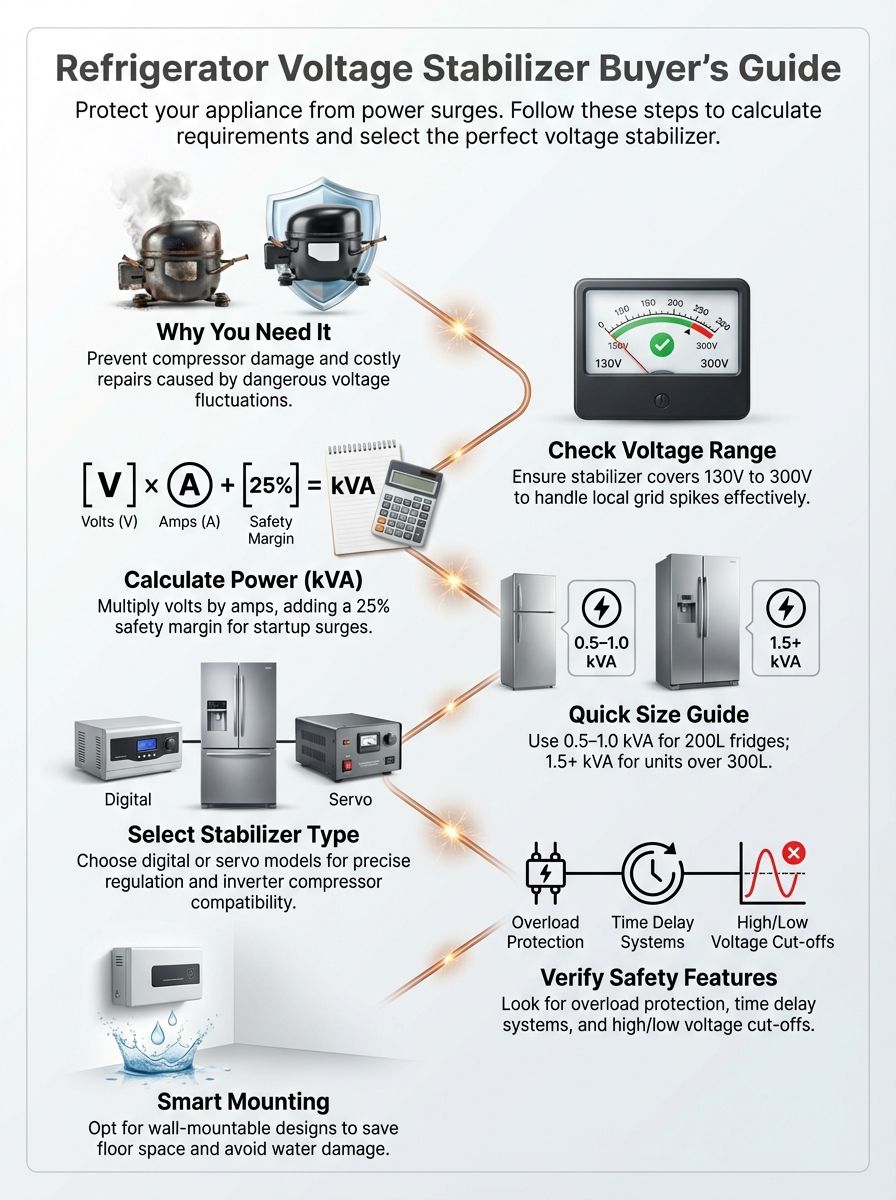
This buyer’s guide explains how much voltage stabilizer required for refrigerator setups, how to choose the right kVA (volt ampere) power rating, and which features matter in real homes, like overload protection, a time delay system, and digital stabilizer controls.
Read on.
Key Takeaways
- Start with your local power reality. If your supply regularly dips low, pick a stabilizer with a wide input window (common ranges include 120V-280V, 130V-290V, and “low-voltage” 90V-260V models).
- Size the kVA by amps or watts. Use kVA = (Volts × Amps) ÷ 1000, or convert watts using an estimated power factor (0.8 is a practical shortcut), then add a 20%-30% buffer for surge current.
- Quick sizing by fridge size (starting point). Many homes land in these bands: up to ~300L often fits 0.5-1.0 kVA, 300L-600L often fits 1.0-1.5 kVA, and 600L+ often points to ~2.0 kVA, then you fine-tune by nameplate amps.
- Don’t buy “kVA only,” buy protection. Prioritize high/low cut-off, surge protection, overload protection, thermal overload protection, and a compressor-friendly time delay system.
The Importance of Voltage Stabilizers for Refrigerators
Voltage stabilizers reduce voltage fluctuations that can stress the refrigerator compressor and the control circuits that run your cooling system, display, and sensors.
That matters more now because modern refrigerators often include inverter compressors and sensitive electronics. When line voltage sags or spikes, you can see symptoms like display resets, unusual compressor noise, or slow cooling.
In India, the declared low-voltage supply rules have traditionally targeted tight variation limits at the point of supply (for example, Rule 54 of the Indian Electricity Rules sets a ±6% band for low and medium voltage). If your home routinely falls outside a safe operating window, a stabilizer becomes a practical layer of appliance protection.
- It protects the “expensive parts.” Compressors, inverter drive boards, and control PCBs cost far more than a stabilizer.
- It reduces nuisance shutdowns. A stabilizer with cut-off and restart delay can prevent repeated stop-start cycling during power cuts.
- It helps maintain performance. Stable input supports steadier cooling and fewer temperature swings for stored food.
A good stabilizer saves the fridge, and your money.
If you’re unsure you need one, run a simple test: plug a basic voltmeter into the same power socket for a day and note the lowest and highest readings you see. Those two numbers should drive your voltage range choice.
Calculating the Necessary Voltage Stabilizer Capacity
Get your stabilizer capacity right and you avoid two common failures: undersizing (cut-offs, overheating, early failure) and oversizing (unnecessary cost).
Start with your refrigerator’s rating plate, usually near the power socket area or behind the unit. Look for input current (amps) or power (watts), and note if it lists a voltage range.
- Find the running load. Use the nameplate amps (best) or watts (good).
- Convert to VA or kVA. VA = Volts × Amps, then kVA = VA ÷ 1000.
- Add a startup buffer. Motors draw higher current at startup. EASA notes that “locked-rotor” current estimates like several times full-load current are common guidelines, so a 20%-30% stabilizer buffer is a sensible starting point for home sizing.
- Match protection features. Capacity without overload protection and cut-off is still a risk.
| What you have | Quick conversion | What to do next |
|---|---|---|
| Amps (A) on the nameplate | kVA = (230 × A) ÷ 1000 | Add 20%-30% buffer, then choose the next higher stabilizer rating |
| Watts (W) on the nameplate | VA ≈ W ÷ 0.8 | Convert to kVA, then add buffer for surge current |
If you want the cleanest answer, measure with a clamp meter that supports inrush capture. That gives you a real-world view of both running amps and startup surge current, which helps you pick a stabilizer that does not trip during compressor starts.
Explore Voltage Ranges
Voltage range is the first filter. A stabilizer can only correct voltage that stays inside its input window. Outside that window, a good unit will cut off to protect the refrigerator.
Here’s a practical way to choose: take your lowest observed voltage and highest observed voltage, then pick a stabilizer whose working range comfortably covers both.
| Common refrigerator-stabilizer input range | What it’s good at | Best fit |
|---|---|---|
| 130V-290V | Everyday fluctuations in many cities and towns | Most modern refrigerators on reasonably stable feeders |
| 120V-280V | Stronger support for deeper low-voltage dips | Areas where evening voltage drops are common |
| 90V-260V | Very low-voltage protection with cut-off at extremes | Homes that regularly sag well below 130V |
| 90V-300V (mainline-style ranges) | Very wide swings, often used for multiple loads | Only if you truly see extreme swings and the unit is sized correctly for the fridge |
For a reality check, note what major brands publish: Microtek lists refrigerator stabilizer models with a 90V-260V working range for low-voltage areas, while V-Guard lists inverter-refrigerator models with a 120V-280V working range and popular refrigerator models in the 130V-290V band.
If your voltage dips below the stabilizer’s low cut-off, the fridge will shut off. That is still better than running the compressor in unsafe conditions, but it tells you your home needs either a wider-range stabilizer, or a power-supply fix from your electricity supply provider.
How to Calculate Power Rating (kVA)
Multiply volts by amps, add margin, and allow for startup surge.
Most home calculations start with 230V because that’s the nominal single-phase supply used in India. Then you size for current.
- If your fridge is rated in amps: VA = 230 × Amps. Example: 2.0A ≈ 460VA, which is 0.46 kVA. Add buffer and you typically shop in the 0.5 kVA to 1.0 kVA band.
- If your fridge is rated in watts: VA ≈ Watts ÷ 0.8. Example: 1000W ÷ 0.8 ≈ 1250VA, which is 1.25 kVA, then add buffer.
Use the fridge size “rules of thumb” as a starting point, then let amps decide the final pick. Manufacturers also publish load capacity in amps, which can be a useful cross-check.
| Typical refrigerator size | Common stabilizer band (starting point) | What to verify |
|---|---|---|
| Up to ~300L | 0.5-1.0 kVA | Nameplate amps, and whether you have deep voltage dips |
| 300L-600L | 1.0-1.5 kVA | Inverter compressor type, surge current behavior, and socket rating |
| 600L+ | ~2.0 kVA | Higher startup loads, longer duty cycles, and voltage range needs |
If you plan to run other heavy electrical appliances like water heaters, induction cooktops, an air conditioner, or a cooker circuit on the same stabilizer, stop and rethink the setup. For refrigerators, a dedicated stabilizer for refrigerator use is usually the safer approach.
Exploring Different Stabilizer Options for Refrigerators
Once you’ve sized voltage range and kVA, pick the technology that matches your grid behavior. The right choice depends on how fast your voltage moves and how sensitive your refrigerator’s electronics are.
| Type | How voltage regulation works | Strengths | Watch-outs |
|---|---|---|---|
| Relay type stabilizers | Switches transformer taps in steps | Affordable, simple, good for mild voltage fluctuations | Stepwise correction and relay wear in choppy power areas |
| Digital stabilizers | Microcontroller logic plus tap switching and fast cut-off | Fast response, clear indicators, good for modern refrigerators | Still needs correct input voltage range for your home |
| Servo stabilizers | Servo motor adjusts a variable transformer smoothly | Smooth correction, strong for wide swings and sensitive loads | Moving parts can need periodic servicing |
| Hybrid stabilizers | Blends fast electronic control with smoother regulation | Balanced performance for irregular supply and frequent power cuts | Higher price, so only worth it if your supply is truly unstable |
Relay Type Stabilizers
Relay type stabilizers are the basic, budget-friendly option. They correct voltage by switching taps, which means the output changes in steps instead of smoothly.
If your electricity supply is fairly steady and you just want a safety net against occasional voltage fluctuations, this category often does the job.
- Best fit: Smaller fridges and homes where lights do not noticeably dim when the refrigerator compressor starts.
- Common pitfall: In “choppy” areas with frequent dips and spikes, the relay switching can become constant. That is when users start hearing frequent clicks and see more cut-offs.
Digital Stabilizers
Digital stabilizers are a strong match for modern refrigerators because they react quickly, offer precise control logic, and usually include clear fault indicators for high voltage, low voltage, and overload events.
They are also easier to troubleshoot because the display or LEDs can tell you whether the unit is stepping up, stepping down, or in protection mode.
- Real-world sizing example: V-Guard lists its VGSD 50 as a 2A refrigerator stabilizer with a 130V-290V working range for fridges up to 300L, and its VGSD 100 as a 4A option for fridges up to 600L in the same working range.
- Another practical option: IFB lists the IVS 13005 R as a digital refrigerator stabilizer with a 130V-290V working range, 2A capacity, and application up to 350L.
- Low-voltage areas: Microtek lists refrigerator stabilizer models with a 90V-260V working range, aimed at deeper voltage dips.
Pick a digital stabilizer if you want strong appliance protection with minimal fuss, especially for inverter compressors and refrigerators that have sensitive display and control boards.
Servo Stabilizers
Servo stabilizers are built for smoother, continuous voltage regulation. Instead of switching taps in steps, a servo motor adjusts a variable transformer to correct the output.
Fuji Electric’s technical guidance describes servo-controlled stabilizers as systems where a sensing circuit feeds a controller, which then drives a servo motor across an autotransformer winding to correct voltage.
- Best fit: Homes with wide, frequent voltage fluctuations, and high-value refrigerators where you want smoother correction.
- Maintenance reality: Because the design uses moving parts, periodic checks can matter more than with basic relay units, especially in dusty environments.
Hybrid Stabilizers
Hybrid stabilizers aim for a middle ground. You get fast detection and cut-off behavior, plus steadier regulation for sensitive loads.
This option makes sense if you face both issues at once: frequent power cuts (so you need a good time delay system) and fast voltage swings (so you want quick correction and strong surge protection).
- Buy it if: Your voltage changes quickly and your refrigerator is electronics-heavy.
- Skip it if: Your supply is mostly stable, because a well-sized digital stabilizer is usually enough.
Essential Features of Voltage Stabilizers for Refrigerators
Capacity and voltage range get most of the attention. Features are what decide whether your stabilizer protects your fridge or just “sits there.”
- High and low voltage cut-off: Prevents operation outside the safe input window.
- Surge protection and over-voltage protection: Adds defense against spikes and electrical surges.
- Overload protection: Cuts off on excess load or internal faults.
- Thermal overload protection: Helps prevent overheating during abnormal conditions.
- Time delay system: Prevents rapid restart after a power outage, which reduces stress on the refrigerator compressor.
- Clear display or indicators: Helps you diagnose low voltage vs high voltage vs overload quickly.
Overload Protection
Overload protection matters because the fridge is not a steady load. The compressor’s surge current at startup can be much higher than its running amps, and that repeated surge can stress underbuilt stabilizers.
Use this quick buying rule: pick a stabilizer that comfortably covers your fridge’s nameplate amps, then add a 20%-30% buffer so overload protection does not trip during normal compressor starts.
- What to look for: Auto cut-off on overload, and a clear overload indicator.
- What to avoid: Using one stabilizer for multiple heavy electrical appliances, which can push it into overload during peak moments.
High and Low Voltage Cut-Off
This feature disconnects the refrigerator if mains voltage goes beyond the stabilizer’s safe window. In practical terms, you’ll see common low cut-offs around 90V, 120V, 130V, or 135V depending on the model, with high cut-offs often near the upper end of the working range.
Your action step is simple: choose cut-off limits that match your local voltage range logs. If your home often drops below 130V, a 130V low cut-off can turn into frequent shut-offs, so you may need a wider-range unit or a supply-side fix.
Wall-Mountable Design
Wall-mountable stabilizers keep the unit away from mopping water, dust buildup on the floor, and accidental impact behind the fridge.
Install it where it can breathe. Give it a little clearance on all sides, keep it away from hot condenser air, and avoid placing it directly behind the refrigerator where heat and vibration are higher.
- Clean setup tip: Keep the cable run short and tidy to reduce loose connections at the power socket.
- Safety tip: Use proper wall plugs and screws, and do not mount on weak, hollow surfaces without support.
Top Recommended Brands of Refrigerator Stabilizers
Below are well-known refrigerator stabilizer brands in India, along with verifiable, model-level specs you can use to compare voltage range, power rating, and protection features.
| Brand | Key Model / Range | Voltage Range & Capacity | Core Features | Best For | Concepts & Tools |
|---|---|---|---|---|---|
| V-Guard | VGSD series (refrigerator stabilisers) | Common working ranges include 130V-290V (2A for up to 300L, 4A for up to 600L). Inverter-focused models list 120V-280V. | High/low cut-off, time delay system (ITDS on select models), indicators or digital display depending on model. | Buyers who want broad service support and fridge-specific models. | amps, surge current, time delay system, voltage cut-off |
| Microtek | EMR / SMART EMR refrigerator stabilizers | Models listed for low-voltage areas include a 90V-260V working range, with common home sizes around 0.5 kVA for fridges up to ~300L. | Digital display, auto start, high/low cut-off, wall-mount designs on many models. | Homes that see deeper voltage dips and frequent power cuts. | low-voltage stabilizer, voltage range logging, kVA rating |
| IFB | IVS refrigerator stabilizers | IVS 13005 R is listed with a 130V-290V working range, 2A capacity, and application up to 350L. | Digital display, wide input window, appliance protection features for refrigerator use. | Buyers who want a straightforward, fridge-specific stabilizer with published specs. | digital stabilizer, voltage regulation, overload protection |
| Everest | Refrigerator stabilizer models (varies by series) | Commonly listed working range is 130V-290V on refrigerator-focused models, including options for double-door refrigerators. | High/low cut-off, thermal overload protection on many models, compact designs. | Value-focused buyers who still want wide input handling. | voltage cut-off, power rating, reliability |
| AULTEN | AD series (home stabilizers) | Refrigerator-friendly listings include 0.75 kVA class options with a 90V-280V operating band, and wide-range home units up to 90V-300V for tougher conditions. | Digital display, cut-off protection, compact wall-mount options depending on model. | Homes that want wide-range handling and a modern display. | voltage stabilizers, energy-efficient setup, surge protection |
| Hybrid Picks | Hybrid and digital-hybrid categories | Varies by brand, so you must verify the working range and kVA for your exact model. | Fast fault response plus steadier regulation behavior. | Homes with irregular supply and frequent voltage fluctuations where basic units keep tripping. | hybrid stabilizer, voltage regulation, appliance protection |
If you want a fast shortlist, treat it like a matching exercise: choose the voltage range that covers your measured lows, choose the kVA that covers your amps with buffer, then confirm you’re getting cut-off, overload protection, and a time delay system.
Conclusion
The right voltage stabilizer is the one that matches your home’s real voltage range and your refrigerator’s real amps.
Size the power rating with a buffer for surge current, then prioritize the features that prevent damage, like overload protection, high and low cut-off, surge protection, and a time delay system.
If your area sees frequent power outages and voltage fluctuations, a well-sized digital stabilizer, and in tougher cases a servo stabilizer or hybrid stabilizer, can protect the refrigerator compressor and extend refrigerator lifespan.
FAQs
1. What stabilizer size do I need for my refrigerator?
Check your refrigerator power rating on the sticker, then pick a voltage stabilizer rated about 20 to 30 percent above that number to handle startup load from the refrigerator compressor and voltage fluctuations.
2. Do modern refrigerators need a stabilizer?
Many modern refrigerators have some built-in voltage regulation, but in areas with frequent electrical surges or high-voltage swings, a stabilizer for refrigerator still helps protect appliance protection and extend refrigerator lifespan.
3. Which stabilizer type is best, servo, hybrid, or digital?
A servo stabilizer works well for a wide voltage range, a digital stabilizer gives fast voltage regulation and energy efficiency, and a hybrid stabilizer blends both; choose based on your local voltage range, surge protection needs, and brand reputation.
4. Will a stabilizer stop power surges and over-voltage?
Good stabilizers include surge protection, thermal overload protection and overload protection, and they cut power during severe high-voltage events to avoid electric shock and damage to electrical appliances.
5. How does a time delay system help the compressor?
A time delay system prevents short-cycling, it gives the refrigerator compressor time to settle before restart, and that helps lower wear and improve refrigerator lifespan.
6. Can a stabilizer reduce energy consumption?
A stabilizer does not cut the fridge’s power consumption much, but energy efficient models waste less power while protecting devices. Use the right power rating and a quality stabilizer if you also run other appliances like water heaters, induction cooktops, cooker, or an air conditioner, and match it to solar power systems or your home electric power setup to avoid extra losses.
