
You know how irrigation plans fall apart the moment grid power dips or a diesel pump runs out of fuel.
A solar pump inverter is the piece that lets your solar panels power a water pump directly, without waiting for the grid and without needing battery backup for normal daytime pumping.
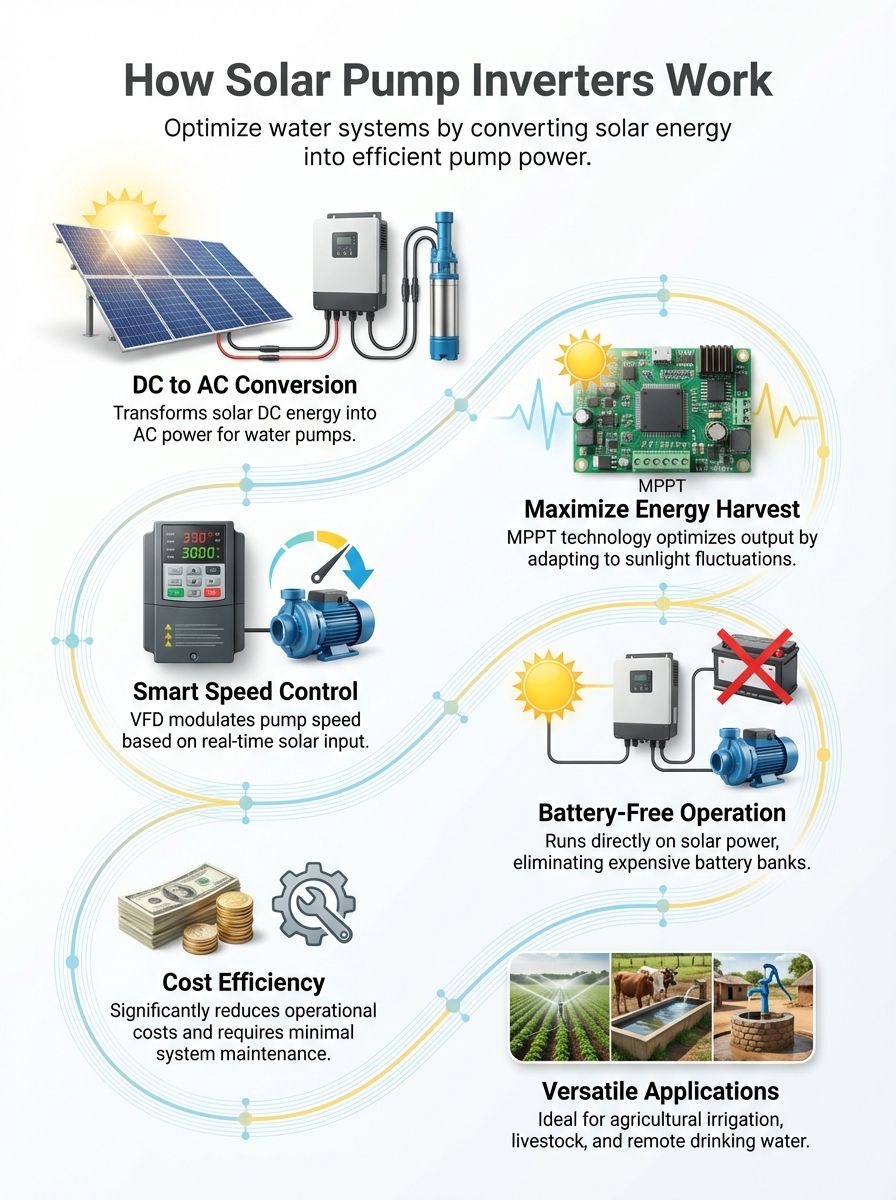
It converts direct current from photovoltaic panels into alternating current, then uses maximum power point tracking (MPPT) and variable frequency drive control to keep the pump running smoothly as sunlight changes.
In this guide, I’ll break down what a solar pump inverter does, the essential components around it, how the inverter and pump work together, and a practical setup checklist for a batteryless solar water-pumping system.
Key Takeaways
- A solar pump inverter converts DC power from solar panels into AC power for water pumps, then adjusts frequency like a VFD to match available sunlight and the pump’s load.
- MPPT tracks the solar array’s best operating point in real time, so you harvest more solar energy throughout the day without relying on batteries.
- Variable frequency control protects motors with soft starts and smoother operation, which can reduce mechanical stress on pipes, seals, and bearings.
- In India, solar pumps are widely used for agricultural irrigation and water supply in remote areas, supported by national and state programs that accelerate adoption.
Exploring the Solar Pump Inverter
A solar pump inverter is a specialized solar inverter built for one job: run a water pump reliably from solar energy, even while sunlight rises, dips, and changes through the day.
Yes, it converts direct current (dc) from solar photovoltaic panels into alternating current (ac), but the real value is control. It continuously adjusts output voltage and frequency so the motor draws power that matches what your PV array can supply at that moment.
In India, MNRE’s March 2023 specification for solar photovoltaic water pumping systems covers centrifugal systems from 1 HP (0.75 kW) to 25 HP (18.75 kW), which is a useful sanity check when you’re sizing real-world solar pumps for farms, villages, and small utilities.
MPPT keeps the inverter “locked in” to the best available solar power point as sunlight shifts.
If you’re comparing options, this is the distinction most buyers miss: a general-purpose inverter focuses on producing AC, while a solar pump inverter focuses on producing the right AC for a pump motor at any moment, so you move more water per day and reduce nuisance trips.
- Soft start: ramps motor speed gradually to reduce inrush current and pipe shock.
- Low-light operation: slows the pump instead of shutting it off immediately when clouds pass.
- Pump protections: settings for dry-run, overload, over-temperature, and under-voltage conditions.
- Automation-ready: works cleanly with tank float switches, level probes, and pressure sensors.
Essential Components of a Solar Pump Inverter
A solar water-pumping system is only as reliable as its weakest component. The inverter may be the brain, but you still need the right PV array, the right motor-pump set, and the right wiring and protections to keep the system stable.
At a minimum, think in four blocks: solar panels (PV modules), the solar pump inverter (your controller and VFD), the water pump (surface or submersible), and the “balance of system” parts (mounting structure, cables, isolators, earthing, and sensors).
- PV array: sized to the pump’s real hydraulic job, not just the motor nameplate.
- Inverter/controller: MPPT + VFD logic + protections matched to the motor type (AC induction, PMSM, or DC).
- Pump and plumbing: correct total dynamic head, pipe diameter, check valves, and filtration for your water source.
- Controls and safety: DC isolator, surge protection, earthing, plus tank-full and dry-run inputs.
| Component choice | What it changes in the field | What you should do |
|---|---|---|
| Surface pump | Easier access for maintenance, but limited suction lift and more priming concerns | Use a foot valve/strainer, keep suction runs short, and prevent air leaks |
| Submersible pump | Better for borewells and deeper water, fewer priming issues | Prioritize dry-run protection and correct cable sizing for long drops |
| AC induction motor | Common, rugged, widely serviceable | Ensure the inverter has clean V/F control and solid overload settings |
| PMSM or DC motor | Can be efficient at variable speeds, depends on the drive design | Confirm motor compatibility and sensor requirements before purchase |
Solar Panel Functions
Solar panels collect sunlight and turn it into DC power, which is the source of energy your inverter manages. In most parts of India, typical solar incidence is often cited in the 4 to 7 kWh per square meter per day range, which is why solar pumps can be so practical for daytime irrigation and water supply.
Installation matters more than many people expect. A few hours of morning shade on the array can easily shift your best pumping window and cut daily water output.
MNRE’s water pumping specification also calls for seasonal tilt adjustment and manual tracking three times per day to improve performance, which is a straightforward “free gain” if you can do it consistently.
- Site for sun: choose a shadow-free location and avoid placing the array near trees that will grow into the panel plane.
- Track simply: adjust the array toward the sun morning, midday, and afternoon if your structure allows it.
- Keep panels clean: if you’re in a dusty belt, plan a simple rinse schedule so soiling does not silently cut power generated.
- Use correct strings: match the inverter’s DC input and MPPT voltage window, then confirm open-circuit voltage stays within limits on cool mornings.
| Practical sizing checkpoint | What to look for | Why it matters |
|---|---|---|
| PV array vs controller capacity | Controller power capacity should be at least equal to the solar panel capacity (Wp) | Prevents “controller bottlenecks” where the array can produce power that the drive cannot use |
| Example: 5 HP pump systems | MNRE’s example lists a 5 HP pump at 3750 W and a minimum PV capacity of 4800 Wp | Helps you avoid undersizing the array, which causes frequent start-stop and low water yield |
| Module mismatch | Keep module-to-module wattage mismatch within tight limits (MNRE lists ±3% for pumping arrays) | Reduces string imbalance and improves MPPT stability |
Inverter Mechanism
A solar pump inverter takes fluctuating DC input from photovoltaic panels and produces AC output that a pump motor can actually use. Internally, it measures DC voltage and current, runs an MPPT algorithm, then uses high-frequency switching (often PWM) to synthesize controlled AC power.
In plain terms, it is doing two jobs at once: it is a power converter, and it is a motor controller.
Most MPPT implementations use well-known control approaches (such as perturb-and-observe or incremental conductance). The goal stays the same: keep the PV array operating near its maximum power point as irradiance and temperature change.
- DC side: the inverter “asks” the solar panels for the voltage and current that yields the most usable DC power.
- Power stage: switching devices convert DC power to controlled AC output.
- VFD logic: the inverter varies output frequency so pump speed tracks available solar input.
- Protections: over-current, over-voltage, over-temperature, phase loss (for three-phase), and dry-run logic protect equipment.
If you’re specifying safety and compliance for a professional install, standards like IEC 62109-2 (PV inverter safety) and IEC 61800-5-1 (adjustable speed drive safety) are commonly referenced in the inverter and drive ecosystem, and they help you frame what “safe design” means beyond marketing claims.
Water Pump Operations
Solar pumps run smart, not hard.
The pump is where your electrical decisions turn into water. Once the inverter supplies AC power, the motor spins the pump, and the pump converts that shaft power into flow and pressure.
The practical reason variable frequency drive control matters is simple: for many centrifugal pumps, changing speed changes output dramatically. You can use the pump affinity relationships as a quick mental model.
- Flow is roughly proportional to speed.
- Head (pressure) is roughly proportional to speed squared.
- Power is roughly proportional to speed cubed.
So if your inverter drops frequency from 50 Hz to 40 Hz during weak sunlight (80% speed), the pump may deliver about 80% flow, about 64% head, and use about 51% power. That is why a solar VFD can keep pumping in low light instead of tripping out.
To make this stable in day-to-day use, technicians usually set a few key parameters based on the pump and site conditions.
- Minimum frequency: prevents stall conditions where the pump spins but does not move useful water.
- Ramp-up and ramp-down time: reduces hydraulic shock and protects pipes and couplings.
- Dry-run behavior: stop and auto-restart logic based on level sensors or inferred flow.
- Tank full logic: a float switch or level probe can stop pumping without human intervention.
Operating Principles of Solar Pump Inverters
A solar pump inverter connects to solar panels on the DC side and to the motor-pump set on the AC side. Good wiring and protection choices are not “nice to have,” they decide whether the system runs for years or fails after a few hot months.
MNRE’s March 2023 specification explicitly calls for an isolator switch between the solar panels and the controller, and it also outlines controller expectations like IP65 enclosure when remote monitoring is included.
Batteryless setup checklist (practical, field-friendly)
- Measure the water job first: confirm total dynamic head, desired daily water output, and water source stability.
- Select the pump: choose surface vs submersible, then match flow and head to your requirement.
- Size the PV array: ensure the array wattage and string voltage sit inside the inverter’s MPPT window, with enough extra margin for midday pumping.
- Match the inverter to the motor: confirm motor type (AC induction, DC, PMSM) and rated power, then set ramp and protection parameters.
- Add sensors that reduce risk: tank-full float switch and dry-run protection are the fastest way to prevent pump damage.
- Protect and ground: install the DC isolator, proper earthing, and surge protection appropriate for your site conditions.
Common mistakes that cause low water output
- Undersized PV array: the pump may start, stall, and restart repeatedly, which overheats motors and stresses the inverter.
- Wrong string voltage: too low and MPPT cannot reach stable operation, too high and you risk over-voltage faults.
- No water storage plan: a tank often delivers more real reliability than batteries for pumping, because it stores the output you actually care about.
- Skipping maintenance basics: dirty solar panels and clogged strainers quietly cut flow long before anything “fails.”
If you need water after sunset, prioritize water storage first. A storage tank is often the simplest backup power supply for pumping, because it stores water, not electrons.
Utilizing Solar Pump Inverters: Applications and Advantages
Solar pump inverters show up anywhere you need dependable water pumping and you want to cut fuel costs, grid power dependence, and maintenance effort. In practice, the “win” comes from pairing renewable energy with variable speed control so the pump matches the sun instead of fighting it.
In India, PM-KUSUM has pushed adoption at scale. The scheme targets roughly 34,800 MW by March 2026 across its components, and public updates have reported that total solar pumps installed or solarized have exceeded 10 lakh, which reflects how mainstream solar pumping has become for agricultural irrigation and rural water supply.
| Application | What usually matters most | What to configure on the inverter |
|---|---|---|
| Agricultural irrigation | Steady daytime flow, low running cost, minimal downtime | MPPT mode, minimum frequency, soft start, optional pressure sensor for drip zones |
| Drinking water supply | Reliability, tank automation, protection from dry-running | Tank-full float input, dry-run logic, auto-restart window, run-hour logging |
| Wastewater treatment and transfer | Variable flows, solids risk, maintenance planning | Current limits, fault logging, slow ramp to protect pipes, scheduled run windows |
Boosting Agricultural Irrigation
For irrigation, a solar pump inverter gives you the cleanest match between sunlight and water demand. When the sun is strong, the drive increases motor speed and you push higher flow. When clouds pass, it reduces speed so you keep moving water instead of shutting down.
If you’re planning around Indian farm realities, it helps to treat the system like a water production line: pump during solar hours, then irrigate from a storage tank when the field needs it.
- Use a storage tank or pond: pump into storage during peak sun, then gravity-feed drip or sprinklers later.
- Stabilize pressure: if you run drip irrigation, consider a pressure sensor and PID control mode if your inverter supports it.
- Watch for start-stop cycling: frequent cycling is a sign of low PV power or wrong minimum frequency settings.
- Plan maintenance by season: dust season often calls for more frequent panel cleaning and strainer checks.
Enhancing Water Supply Systems
For drinking water and community supply, the inverter’s automation features are often more important than peak horsepower. A float switch, level probes, and clear fault indicators can turn an unattended pump into a predictable utility asset.
MNRE’s March 2023 specification also includes durability and site-condition cues that matter for public systems, such as recommending stainless steel grade 304 or higher for submersible pump parts in contact with water, and calling out grade 316 for higher salinity/coastal conditions.
- Build around a tank: set the inverter to stop when the tank is full and restart when the level drops.
- Protect the source: set dry-run protections so low borewell levels do not burn out the pump.
- Design for the environment: in coastal areas, use corrosion-resistant materials and confirm PV modules meet salt-mist expectations.
- Monitor what matters: run hours and fault logs help you schedule preventive service before a breakdown hits water supply.
Conclusion
A solar pump inverter links solar photovoltaic panels to water pumps by converting direct current into alternating current and then controlling motor speed through MPPT and variable frequency drive logic.
This is why solar pumps can keep working through changing sunlight and still deliver useful daily water output without relying on grid power.
If you size the PV array correctly, enable the right protections, and store water in a tank, you get a low maintenance solar water-pumping system that fits irrigation, drinking water, and wastewater treatment needs.
Routine checks, especially panel cleanliness and basic electrical protections, keep energy efficiency high and protect freshwater resources over the long run.
FAQs
1. What is a solar pump inverter?
A solar pump inverter converts power from solar panels into usable power for pumps. It ties a solar power system and solar inverters to water pumping systems, and it helps solar energy work as a renewable source of energy and clean energy.
2. How does a solar pump inverter work?
It takes direct current (dc) power from solar panels and uses maximum power point tracking (mppt) to boost solar energy optimization. Then it converts to alternating current (ac) power and uses variable frequency drives (vfd) or ac drives to control pump speed, which raises energy efficiency and energy savings.
3. Can a solar pump inverter run a solar water pump or submersible pumps?
Yes, it powers a solar water pump and submersible pumps in a solar-powered water pumping system. People use it for drinking water supply, agricultural irrigation, off-grid water systems, wastewater treatment, and other solar pump applications.
4. What are the environmental and cost benefits?
You get energy savings, lower fuel use, and less impact on the environment, because solar energy is a renewable energy, a renewable source of energy, and clean energy. This also protects freshwater resources and supports sustainable energy solutions.
5. Do solar pump inverters need grid connection or backup power?
Many systems work without grid connection, which fits remote areas and systems without power lines. For night use or long low sun, add batteries or a backup power supply, and you can also support washers, heating, cold storage, treatment plants, wastewater treatment plants, and sewage treatment facilities when needed.
6. How much maintenance do they need?
They are low maintenance compared to diesel engines, and they cut costs in energy systems. Regular checks of solar panels, the solar pump inverter, the pump, and predictive maintenance tools keep the system reliable.