
You know how one clean-looking power supply problem can hide three different risks: a hard power failure, slow brownouts, and fast voltage spikes.
In India in 2026, that’s the practical reason an uninterruptible power supply (UPS) still earns its keep for a home PC, modem, and even more sensitive loads that hate unstable mains voltage.
A UPS gives you backup power long enough to save work and shut down safely, and it also conditions power to reduce crashes, corrupted files, and hardware stress.
Top brands you’ll see in India include APC, Microtek, Luminous, Zebronics, and Amaron.
In this guide, I’ll show you what really drives UPS pricing (VA vs watts, battery type, and topology), share updated 2026 India price bands and model examples, and give you a quick sizing checklist so you can buy once and stop thinking about power outages.
Key Takeaways
- In 2026 India, home and small office uninterruptible power supplies (ups) commonly start around ₹2,000 for basic 600VA units, and true online UPS systems can move into the ₹20,000+ range for 1kVA class devices (based on India listings updated in February 2026).
- Major brands include APC, Microtek, Luminous, Amaron, Zebronics, artis, Elista, and several value brands, and prices swing based on real watt capacity, voltage regulation features, and service support.
- Battery chemistry matters: most compact units use sealed lead-acid batteries, while lithium UPS options cost more upfront but can reduce replacement frequency and cut recharge time.
- A “big discount” is common in online listings, so compare the selling price to the watts, outlet count, and battery size, not just the percentage off.
Factors Influencing Uninterruptible Power Supply Prices in 2026
UPS pricing in 2026 is less about the logo on the box and more about three engineering choices: how much power it can actually deliver (watts), how it behaves during voltage fluctuations (topology and regulation), and what kind of batteries it uses.
There’s also a compliance angle. A BIS circular dated October 15, 2025 extended the implementation timeline for the updated IS 16242 (Part 1) UPS safety standard to November 19, 2026, which is a good reason to check markings and product documentation when you buy in 2026.
- Capacity (VA and watts): Higher watt output costs more, and it’s what decides what you can run.
- Topology: Offline, line-interactive, and online UPS designs protect against power interruptions in different ways.
- Battery system: Chemistry, battery size, recharge time, and replacement cost change total ownership cost.
- Power quality features: AVR, surge protection, overload protection, short circuit protection, and waveform type all add cost.
Capacity and Power Output
Start with your load in watts, not just VA. VA is the apparent power rating, but your devices consume real power in watts, and many home UPS models deliver only a fraction of their VA rating as usable watts.
A simple rule you can use when comparing models is: watts = VA × power factor. For many entry UPS units, you’ll see an effective power factor around 0.6, so a 600VA unit often lands near 360W class output.
Here’s how to turn that into a buying decision:
- Add up device watts (PC, monitor, router, NAS). If you cannot find a watt label, use your adapter rating or a plug-in power meter.
- Add a buffer so the UPS runs cooler and stays stable during spikes. Schneider Electric’s battery guidance commonly recommends keeping UPS load below 80% of rated capacity for better runtime and battery life.
- Match outlets and plug type to your setup. If you need 3-pin 6A sockets for a PC and modem, verify the outlet count before you pay for more VA than you need.
Real-world examples help anchor the price jumps. A 600VA line-interactive unit is usually the entry point for home backup power, while an 1100VA class UPS can support heavier PC loads, and a true online UPS in the 1kVA class typically starts far higher. For instance, Microtek’s online double-conversion 1kVA model (MAX+ series) is listed around ₹24,166 in India, which reflects the added cost of continuous power conversion and tighter output control.
Choose capacity to match your load in watts, then verify outlet count and voltage specs so the UPS fits your actual devices.
Battery Type and Backup Duration
Battery chemistry drives both runtime and what you’ll spend later on replacements. Most compact UPS units in this price guide use sealed lead-acid batteries, while higher-end units may offer lithium packs.
For lead-acid UPS batteries, Schneider Electric notes a typical expected life of three to five years under recommended conditions, and temperature is the silent killer. Their guidance also warns that every 8°C rise in operating temperature can cut battery life roughly in half, which matters in warm rooms and closed cabinets.
To translate battery specs into a fast runtime sanity check, look for two numbers:
- Battery voltage (V): Many compact units use 12V, while larger units may use 24V or 36V battery buses.
- Battery capacity (Ah): A common small UPS battery is 12V 7Ah to 12V 7.2Ah class.
From there, treat runtime claims as load-dependent estimates, not guarantees. As load rises, the battery drains faster and the UPS may hit its low-voltage cutoff sooner.
If you’re considering lithium for critical use, the main practical win is replacement cycle and recharge time. Eaton’s UPS battery guidance summarizes typical ranges as 3 to 5 years for lead-acid versus 8 to 10 years for lithium-ion in many UPS applications, with lithium also charging faster in many designs.
One common pitfall is oversizing runtime expectations for motor loads. Refrigerators and devices with compressors can draw high inrush current, so a small PC UPS may alarm or drop even if the steady-state watts look safe. If your priority is refrigerator support, you usually need a higher surge-capable system or an inverter-style backup designed for motor starts.
Brand and Additional Features
Brand does affect pricing, but usually through service network, warranty handling, and the consistency of published specs.
On the technical side, the feature that saves the most frustration in India is automatic voltage regulation (AVR). In a line-interactive UPS, AVR can boost or trim voltage without switching to battery as often, which preserves battery health during day-to-day power fluctuations.
It also helps to understand the common topology labels used in industry testing. Fuji Electric’s UPS classification guide ties common UPS designs to IEC 62040-3 performance classes: offline (VFD), line-interactive (VI), and online double-conversion (VFI). That vocabulary makes spec sheets easier to compare across brands.
Two “insider” behaviors to watch for show up in real product settings:
- Battery saver modes can change runtime behavior. Schneider Electric’s India FAQ for the BX600C-IN notes a Battery Saver feature that can increase battery life, but it can reduce runtime.
- Ultra-low loads can trigger shutdowns. Another Schneider Electric India FAQ notes a “no load shutdown” behavior in Battery Saver mode: if the connected load draws less than 30W for more than 5 minutes while on battery, the UPS can shut down. That matters if you’re backing up only a modem or router.
On safety and device protection, these features tend to justify paying more when you have valuable electronics:
- Surge protection and filtering for spikes and electrical noise.
- Overload protection and clear alarms so you do not discover a sizing mistake during a blackout.
- Short circuit protection and stable output voltage for sensitive power electronics.
Price Range of Uninterrupted Power Supplies in India
Prices move quickly in online marketplaces, so use bands to narrow your shortlist, then compare watts, battery size, and topology.
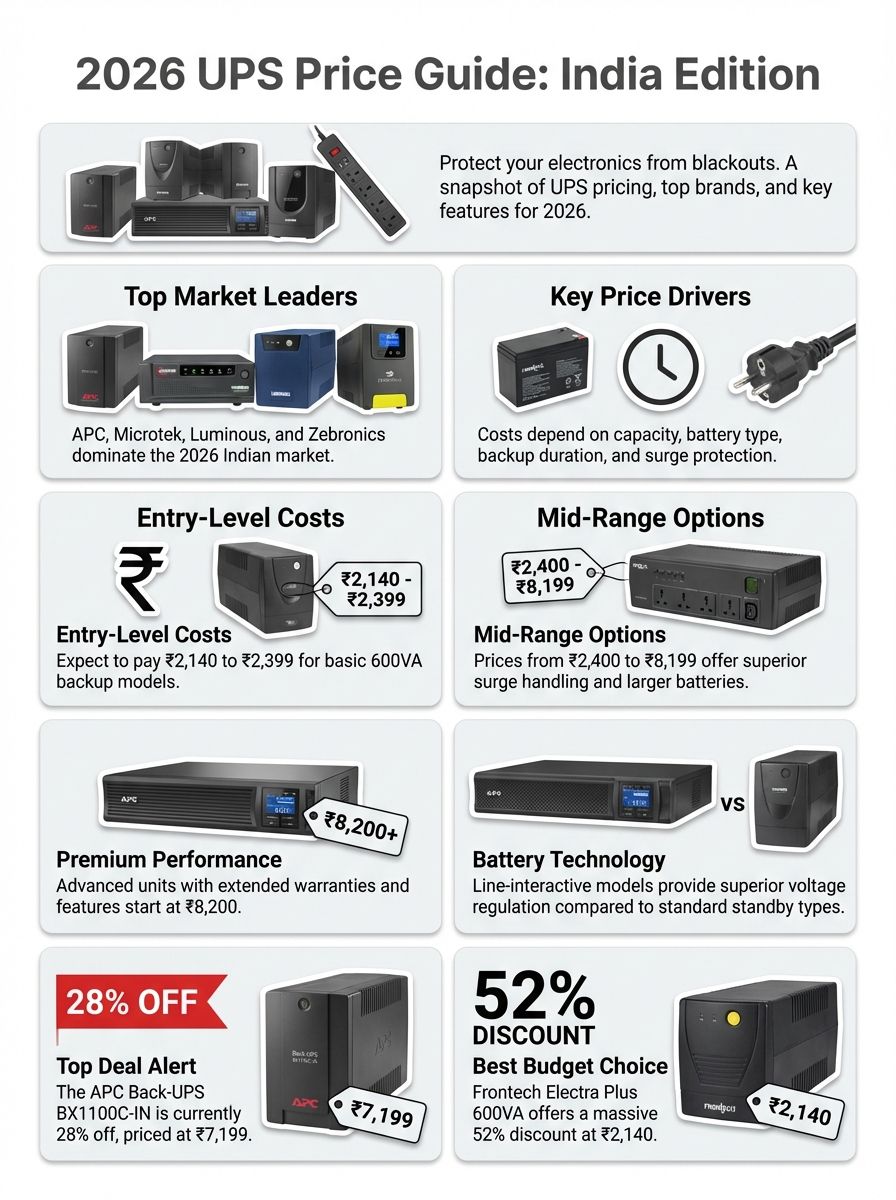
As a market snapshot, India price lists updated in February 2026 show 600VA class devices near ₹2,000 to ₹3,500, while online double-conversion 1kVA units commonly land well above ₹15,000.
| Price Band (INR) | Typical Capacity | Example Models | Listed Price | Discount | Notes |
|---|---|---|---|---|---|
| ₹1,900 – ₹3,500 | ~600VA (often ~360W class output) | Entry 600VA units from value brands; APC BX600C-IN often appears near this band in dealer listings | ~₹1,999 to ~₹3,500 | Discounts vary by seller and season | Best for router + basic desktop safe shutdown. Verify outlets (India 6A sockets vs universal). |
| ₹3,501 – ₹9,000 | 600VA to ~1500VA line-interactive | APC Back-UPS BX1100C-IN; artis Powersafe 1500VA; mid-range Microtek and V-Guard models | ~₹7,199 (BX1100C-IN in many listings); up to ~₹8,199 on some 1500VA models | Often 10% to 30%+ depending on listing | Common sweet spot for PCs, monitors, and networking gear. Check watt rating and AVR input range. |
| ₹9,001 – ₹15,999 | Higher capacity line-interactive, some entry online models | Selected higher capacity UPS models | Varies by topology and battery pack | Discounts vary widely | Pay attention to waveform and fan noise if it will sit under your desk. |
| ₹16,000 – ₹30,000 | Online UPS (double-conversion) around 1kVA | Microtek ON LINE UPS 1KVA (MAX+ series) | ~₹24,166 (listed selling price) and ~₹25,190 (MRP) for one popular 1kVA online model | Often low single digits to mid-teens on official listings | True online UPS for clean continuous power supply. A better fit for servers, labs, and sensitive setups. |
Popular UPS Models and Their Costs
Use this table as a comparison scaffold. Treat the selling price as a moving target, then validate the watts, battery size, and features that affect your backup time.
| Model | Type | Voltage | Capacity | Output | Selling Price (₹) | Regular Price (₹) | Discount | User Rating |
|---|---|---|---|---|---|---|---|---|
| APC Back-UPS BX1100C-IN | Line-interactive | 230 V | 1100 VA | 660 W (commonly listed) | 7,199 | 10,100 | 28% | N/A |
| Frontech UPS Electra Plus 600VA | N/A | 220 V | 600 VA | 360 W | 2,140 | 4,500 | 52% | N/A |
| LUMINOUS LB600PRO 600VA UPS -PRO | N/A | 230 V | 600 VA | N/A | 2,399 | 3,400 | 29% | N/A |
| Microtek LEGEND 650 | Line-interactive | 230 V | 650 VA | N/A | 2,499 | 2,799 | 10% | N/A |
| APC BX600C-IN BACK-UPS 600 | Line-interactive | 230 V | 600 VA | 360 W (common class) | 3,399 | 4,100 | 17% | N/A |
| V-Guard Sesto 600 | N/A | 230 V | 600 VA | N/A | 2,788 | 3,550 | 21% | N/A |
| artis Powersafe 600VA | Line-interactive | N/A | 600 VA | 360 W | 3,201 | 4,499 | 28% | 3.8 (364 reviews) |
| artis Powersafe 1500VA | Line-interactive | N/A | 1500 VA | N/A | 8,199 | 10,999 | 25% | 3.9 (89 reviews) |
| Microtek ON LINE UPS 1KVA 1PH:1PH 36V MAX+ | Online (double-conversion) | N/A | 1 KVA | N/A | 24,166 | 25,190 | 4% | N/A |
Conclusion
A good uninterruptible power supply protects equipment and reduces data loss during power failure events.
In India, prices still start near ₹2,000 for basic backup power, and they climb fast as you move into higher watt capacity, better voltage regulation, and true online UPS designs.
Before you buy, size to watts with headroom, confirm battery behavior for low loads, and pick the topology that matches your risk from power outages and voltage fluctuations.
FAQs
1. What does an uninterruptible power supply (UPS) cost in India for 2026?
Prices vary by type and capacity. Portable UPS for home use often cost around ₹3,000 to ₹12,000, line-interactive UPS sit near ₹10,000 to ₹35,000, and online UPS for industrial applications start around ₹50,000 and go much higher depending on backup power and battery backup.
2. What key factors drive the price of an uninterruptible power supply?
Power electronics, battery capacity, backup time, input voltage and output voltage matter most. Features like overload protection, short circuit protection, recharge time, and ability to handle voltage fluctuations raise costs.
3. Which UPS type fits a small office or home?
A tower UPS or a portable UPS usually fits small loads and basic data loss prevention needs. For more sensitive gear, choose a line-interactive UPS; for critical systems, pick an online UPS.
4. How long should the battery backup last for data loss prevention?
Aim for at least 10 to 30 minutes to save work and shut down safely, for many offices. Critical systems or servers need longer backup time or an online UPS, often used in industrial applications.
5. Will a UPS protect against power surges and power fluctuations?
Yes, most uninterruptible power supplies include protection for power surges and voltage fluctuations, and they use power electronics to smooth input from grid power. Look for models with overload protection and short circuit protection for stronger defense.
6. What extra costs and upkeep should I expect?
Plan for battery replacement, periodic tests, and possible installation fees, plus recharge time after outages. Smart units may need internet connectivity or internet access for remote monitoring, and you should check mains voltage, hertz, and input/output specs during purchase.